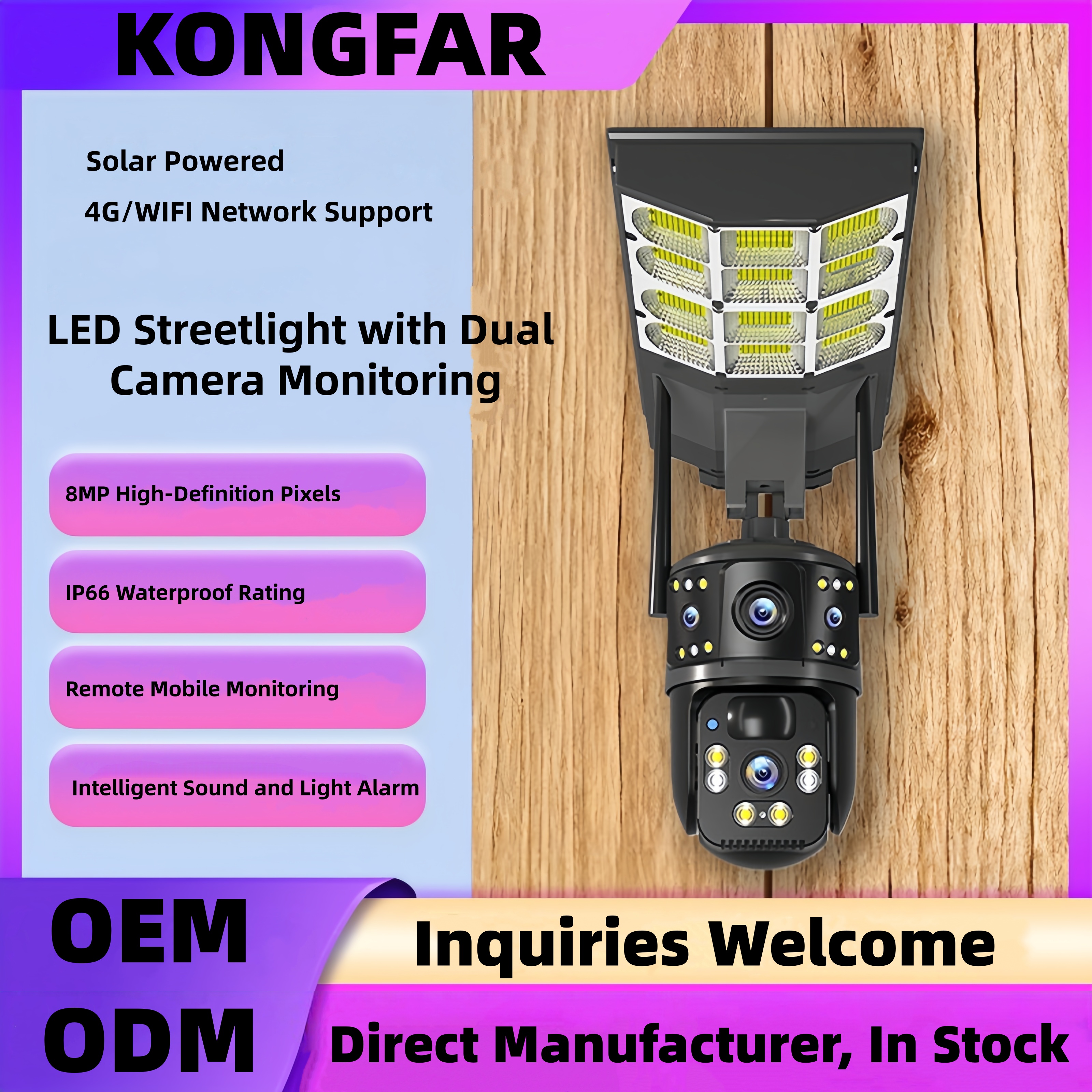
Solar-Powered LED Street Light with Integrated Dual-Camera Surveillance

Description

Event-Driven Outdoor Surveillance and Lighting for Off-Grid Deployments


* Lens Specifications: 4mm + 4mm;
* Resolution: Main stream: 2304*2592, Sub stream: 800*896;
* LED Illumination: 240 PCS human body induction lighting/APP-controlled light switch;
* Video Storage: Supports TF card (32~256G) recording storage;
* Voice Intercom: Supports two-way voice intercom;
* Night Vision Mode: Supports two adjustable night vision modes (infrared mode/full color mode);
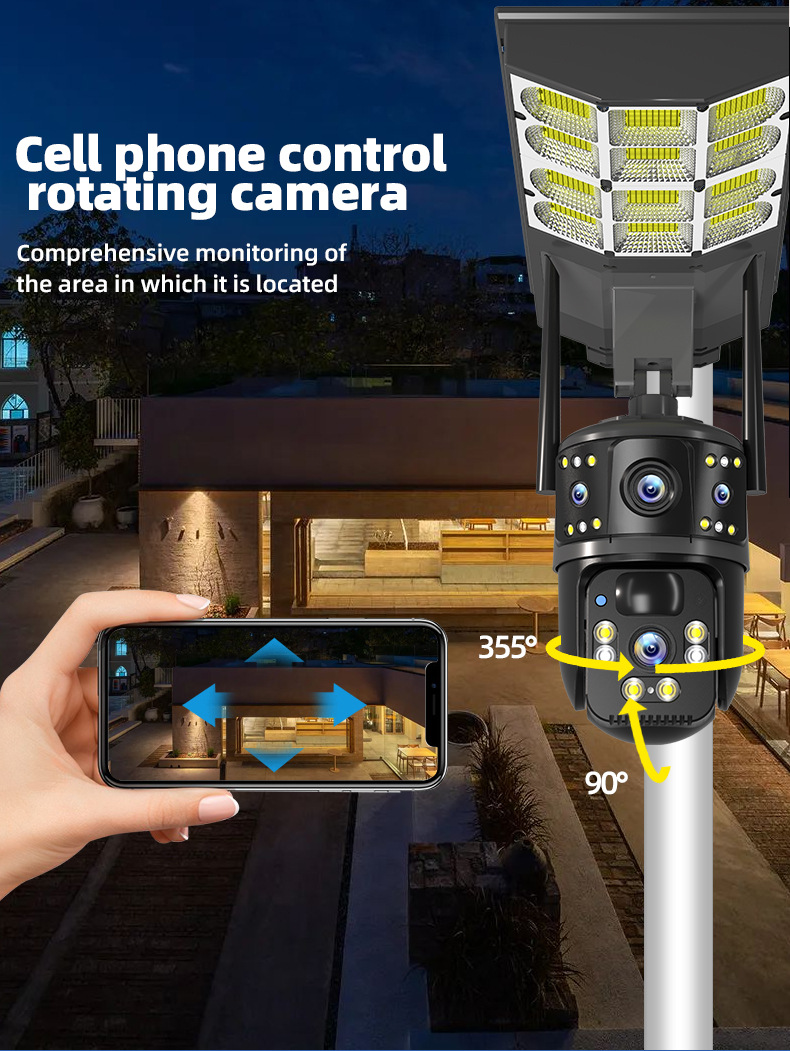
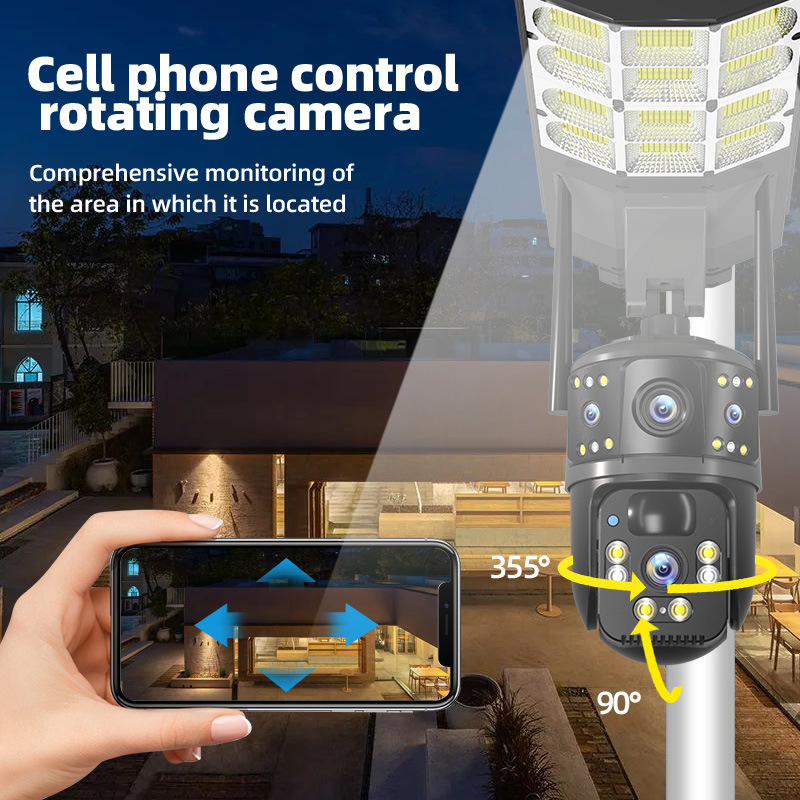
* Gimbal Rotation: Gimbal supports 355° left and right, 90° up and down;
* Application Software: Supports iOS and Android;
* PIR Detection Range (Motion-Based Detection): 10 meters, 120 degrees;
* Operating Temperature Range (Outdoor Use): -20°C ~ 55°C;
* Applicable Humidity Environment: 20% ~ 80%;
* Solar Panel Power (Off-Grid Operation): 12W;
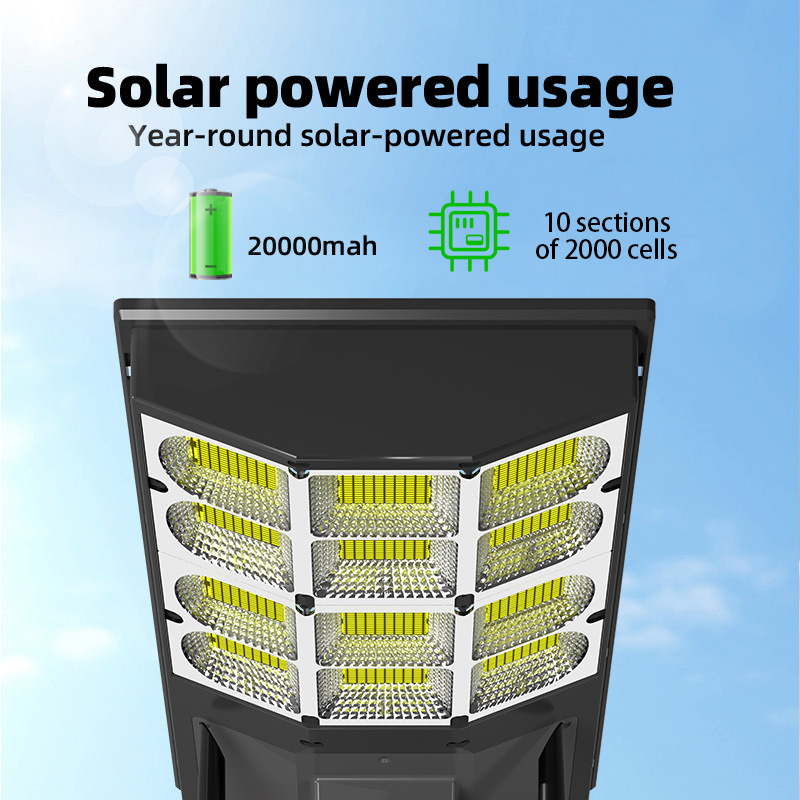
* Charging Interface: 5V Type-C interface; Battery capacity: 20000mAh (10 batteries); can be set to record all day; automatic night light (activates low-power mode and switches to sensor-activated light mode when battery level drops below 50%);
* Solar panel power: 12W;
* Packaging dimensions: 254*249*463mm; Single weight: 3.8KG.

Solar-Powered LED Street Light with Integrated Dual-Camera Surveillance

Product Details

Solar-Powered LED Street Light with Integrated Dual-Camera Surveillance System


Engineering Conclusion


This solar-powered LED street light with integrated dual-camera surveillance is engineered for public infrastructure environments where lighting and visual monitoring must operate reliably without stable grid power.
Its engineering value is defined by deployment efficiency, functional integration, and long-term operational predictability, rather than by lighting output or camera resolution alone.

Engineering Problem This System Addresses


In outdoor infrastructure projects, lighting and surveillance are often deployed as separate systems, each requiring independent power supply, mounting structures, cabling, and maintenance cycles.
This separation increases installation complexity, failure points, and long-term operational cost—particularly in areas where grid access is limited or deployment speed is critical.

This system addresses these challenges by integrating illumination and surveillance into a single solar-powered unit, reducing redundancy while maintaining essential functionality.

Integrated System Architecture Overview


The system combines photovoltaic generation, energy storage, LED lighting, and dual fixed optical channels into a unified outdoor infrastructure unit.
Lighting poles serve as both illumination sources and observation platforms, aligning physical placement with predictable coverage geometry.

A centralized power management logic coordinates energy allocation between lighting and surveillance based on real-world solar availability rather than peak theoretical output.

Why Integrating Lighting and Surveillance Matters


Integrating surveillance directly into street lighting infrastructure eliminates the need for separate camera poles, auxiliary power supplies, and duplicated installation work.
This approach reduces external wiring exposure, simplifies site planning, and lowers the probability of long-term system failure.

More importantly, it aligns visual monitoring coverage with areas already defined by lighting requirements, improving predictability and consistency in public-space observation.

Engineering Boundary Conditions & Design Assumptions


System performance is defined under the following engineering boundary conditions:
Grid Dependency Constraint
Designed for environments where grid power is unavailable, unreliable, or cost-prohibitive to extend.

Solar Resource Assumption
Energy autonomy is based on realistic daily solar irradiation patterns rather than peak laboratory conditions.

Lighting Geometry Constraint
Coverage assumptions align with roadway, pathway, or perimeter layouts where lighting poles define observation zones.

Energy Prioritization Logic
During extended low-generation periods, baseline lighting safety and essential surveillance are prioritized over peak performance.

Maintenance Access Assumption
Optimized for infrastructure deployments with limited routine maintenance access.

Decision-Relevant Parameters


The following parameters are presented as engineering decision drivers, not isolated specifications:

Lighting–Surveillance Power Balance


Energy allocation logic determines how illumination intensity and surveillance activity are balanced under varying solar conditions.

Dual-Camera Field-of-View Coverage


Camera orientation is selected to align with roadway or pedestrian flow, minimizing blind zones without mechanical movement.

Integrated Power Architecture


Shared energy storage and control logic reduce subsystem conflicts and long-term degradation risks.

Engineering Decision Rationale


From an engineering standpoint, this architecture is selected to reduce infrastructure redundancy while maintaining functional continuity:
✅ Shared power and mounting reduce failure points
✅ Fixed dual-camera coverage avoids mechanical wear
✅ Energy-aware prioritization ensures predictable operation
✅ Integrated deployment shortens installation timelines

Engineering Decision Q&A


What engineering problem does a solar-powered street light with integrated surveillance solve?


This system is engineered to provide simultaneous public-area illumination and persistent visual monitoring in locations where grid power availability, cabling reliability, or deployment speed constrain conventional infrastructure solutions.
Its primary value lies in reducing deployment complexity while maintaining functional continuity for both lighting and surveillance.

Under what conditions is an integrated lighting-and-surveillance architecture the correct engineering choice?


An integrated architecture is appropriate when lighting poles already define observation geometry and when adding separate surveillance power and mounting systems would introduce redundancy, higher failure probability, or increased installation cost.
It is particularly suited for roads, perimeters, and open public spaces requiring predictable coverage zones.

How does integrating surveillance into a solar street light affect system reliability?


Integration reduces external wiring, auxiliary mounting structures, and independent power subsystems, thereby lowering long-term failure points.
Reliability improves when lighting and surveillance share a unified power management logic rather than operating as loosely coupled systems.

Why is dual-camera configuration selected instead of a single viewing channel?


Dual-camera configuration enables bi-directional or complementary field-of-view coverage aligned with roadway or pathway geometry.
This eliminates blind zones inherent to single-direction observation and avoids reliance on mechanical repositioning.

How does solar energy availability influence lighting and surveillance prioritization?


Solar availability governs how illumination intensity and surveillance duty cycles are balanced.
Engineering logic prioritizes baseline lighting safety and essential visual monitoring during extended low-irradiance periods rather than maximizing peak brightness or continuous high-frame-rate recording.

Under what conditions does combined lighting and surveillance performance become constrained?


Performance becomes constrained only when prolonged low solar generation exceeds the designed autonomy window and energy recovery remains insufficient.
In such cases, systems transition to reduced illumination levels and prioritized visual coverage rather than full shutdown.

Is this architecture suitable for permanent unattended public infrastructure deployment?


Yes, provided site conditions align with defined assumptions regarding solar exposure, traffic patterns, and acceptable maintenance intervals.
When these conditions are met, integrated solar lighting and surveillance systems operate predictably without reliance on continuous grid power or frequent field intervention.

When does an integrated street-light surveillance system offer limited engineering advantage?


Integrated systems offer limited advantage in environments where grid power is stable, cabling is readily available, and surveillance geometry does not align with lighting pole placement.
In such cases, independent lighting and camera systems may provide greater configuration flexibility.

Engineering Takeaway


This system should be evaluated as an integrated infrastructure solution, not as a lighting upgrade or a camera add-on.
Its engineering value lies in how effectively it reduces deployment complexity, aligns coverage with public-space geometry, and sustains reliable operation under real-world energy constraints.
Product Structure

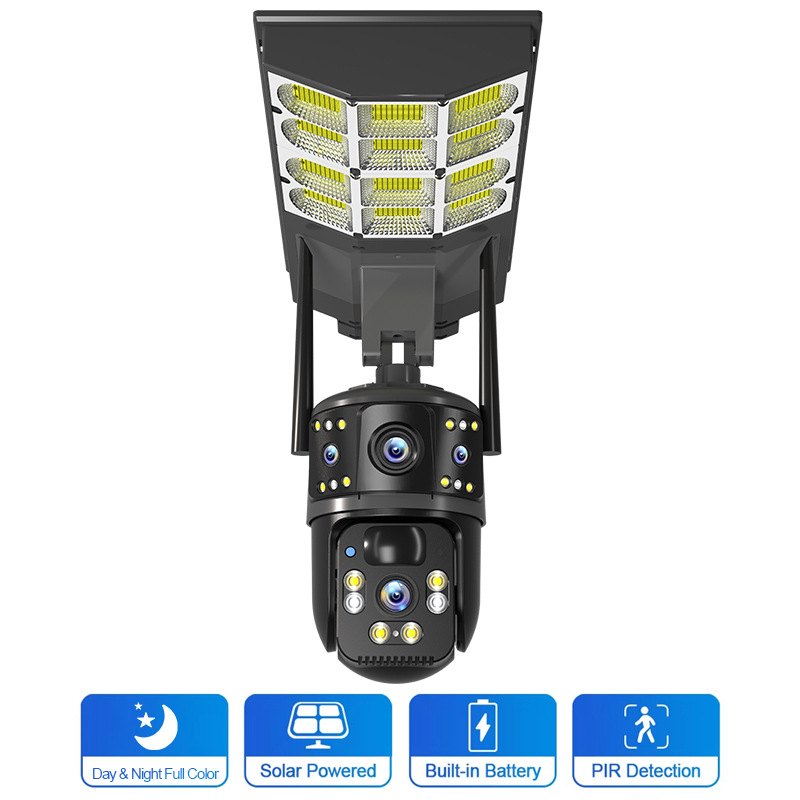
Solar-powered LED streetlight with integrated dual-camera surveillance module and built-in battery system, engineering structure view for outdoor security lighting applications in Southeast Asia and Africa

Solar-powered LED streetlight surveillance system highlighting day and night full color imaging, built-in battery, and PIR motion detection, structural reference image for off-grid deployments

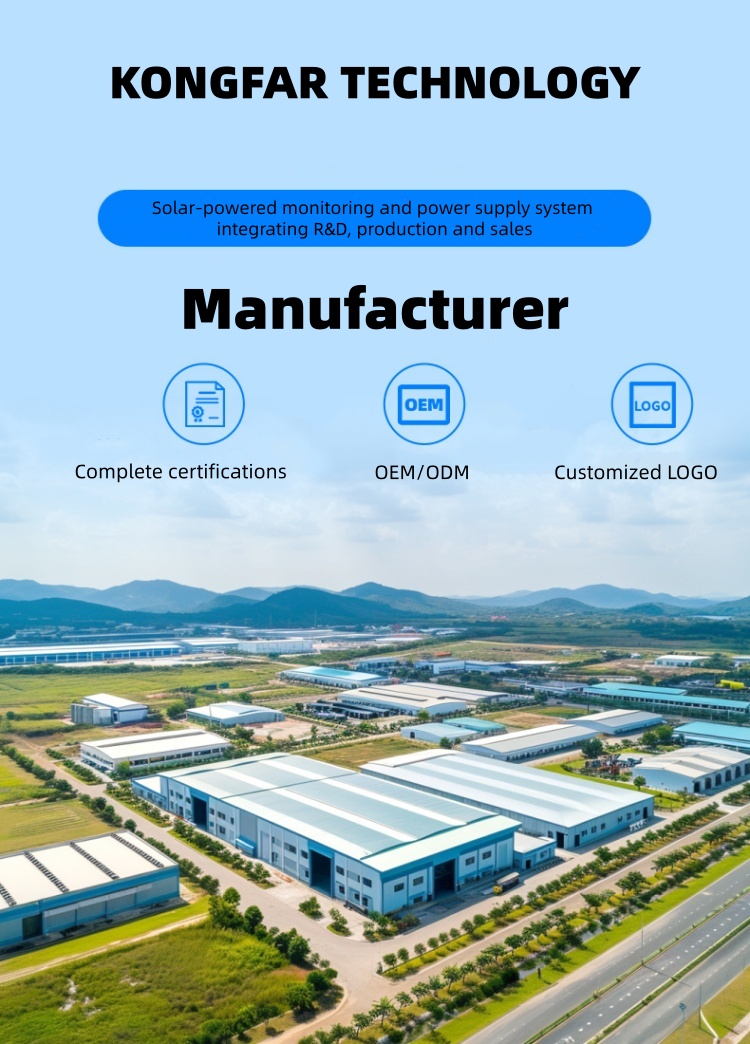
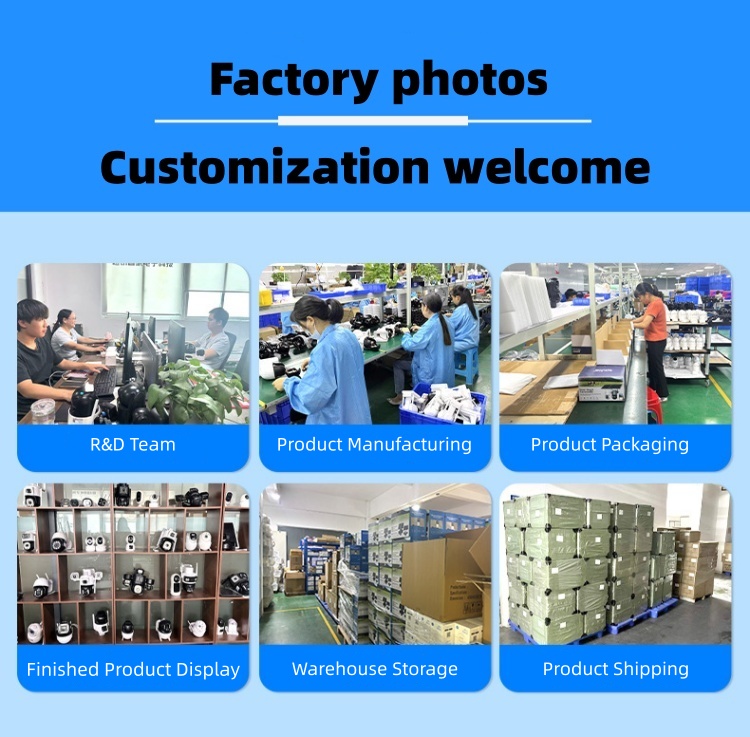
Aerial view of a solar security camera manufacturing facility showing integrated R&D, production, and OEM ODM capabilities for solar-powered monitoring systems

Manufacturer-Level Integration for Solar-Powered Monitoring Systems


This product is backed by Shenzhen Kongfar Technology Co., Ltd., a manufacturer specializing in solar-powered monitoring and power supply systems with integrated R&D, production, and global delivery capabilities.
Unlike trading-based supply models, Kongfar operates a vertically integrated manufacturing framework that controls system design, component selection, assembly, testing, and OEM/ODM execution under one roof.


The manufacturing base supports projects requiring off-grid solar surveillance equipment for infrastructure, agriculture, energy, and remote-area security deployments across multiple regions, including North America, Europe, Australia, and emerging off-grid markets.
This structure ensures compliance alignment, stable lead times, and consistent system performance across varied environmental and regulatory conditions.


With complete certifications, OEM/ODM customization pathways, and brand-level logo integration, the factory setup is designed to support B2B procurement, system integrators, and project-based buyers seeking long-term supply continuity rather than one-off devices.

End-to-End Manufacturing Workflow for Solar-Powered Surveillance Systems


This system is supported by a full-cycle manufacturing workflow, covering R&D engineering, component assembly, system integration, packaging, warehousing, and outbound logistics.
Each stage operates within a controlled production environment to ensure consistency, traceability, and repeatability for solar-powered surveillance systems supplied to project-based and OEM customers.


The in-house R&D team focuses on system architecture, power matching, and environmental adaptability, while dedicated production lines handle device assembly and functional testing under standardized procedures.
Finished units undergo structured packaging and inventory management, enabling stable delivery for batch orders, customized configurations, and long-term supply agreements.


This manufacturing structure is designed to support OEM/ODM customization, regional compliance requirements, and multi-market deployment, providing system integrators and distributors with a reliable production and shipping foundation for off-grid monitoring applications.

Factory photos showing research, manufacturing, packaging, warehouse storage, and shipping processes for solar-powered security cameras
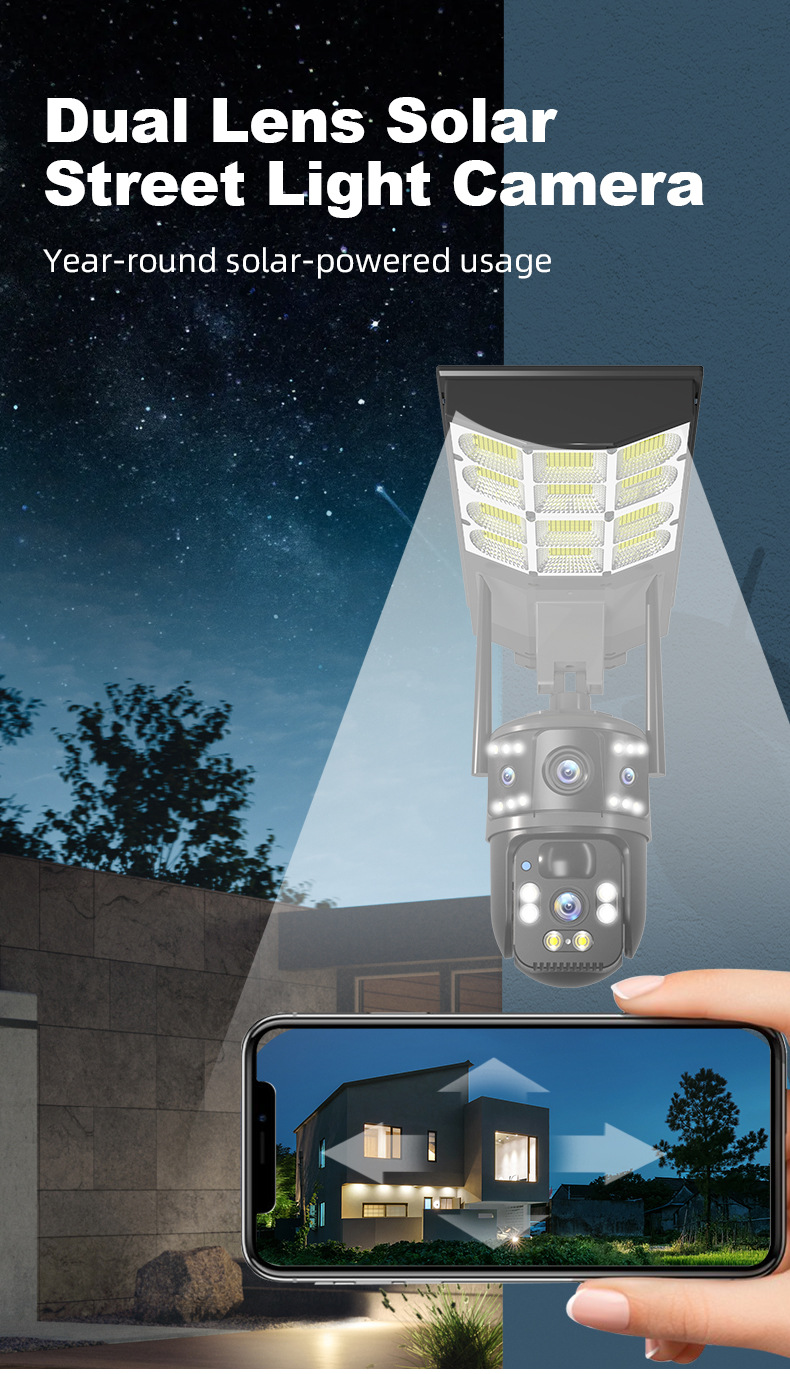
Dual-lens solar-powered LED street light camera illuminating and monitoring residential outdoor areas at night for off-grid security applications in Southeast Asia and Africa

Dual-Lens Solar Street Light Camera as an Integrated Off-Grid Public-Area Monitoring Node

This dual lens solar street light camera is defined as a permanently deployed, off-grid surveillance and lighting node designed for year-round operation in areas without stable grid power, where both night illumination and continuous visual monitoring are required from a single infrastructure point. The system integrates a solar-powered street light module with a dual-lens camera architecture, allowing one optical channel to maintain wide-area situational awareness while the secondary lens focuses on target-level detail, reducing blind zones commonly caused by single-lens lighting fixtures. This architecture is essential in residential streets, coastal communities, rural roads, and public walkways where cabling is impractical, maintenance access is limited, and monitoring continuity must be preserved across seasonal daylight variation. By combining autonomous solar energy harvesting, on-fixture energy storage, and dual-perspective imaging within a single pole-mounted unit, the system functions as a long-term monitoring solution that supports remote viewing, nighttime security visibility, and infrastructure simplification without relying on external power or separate lighting installations.

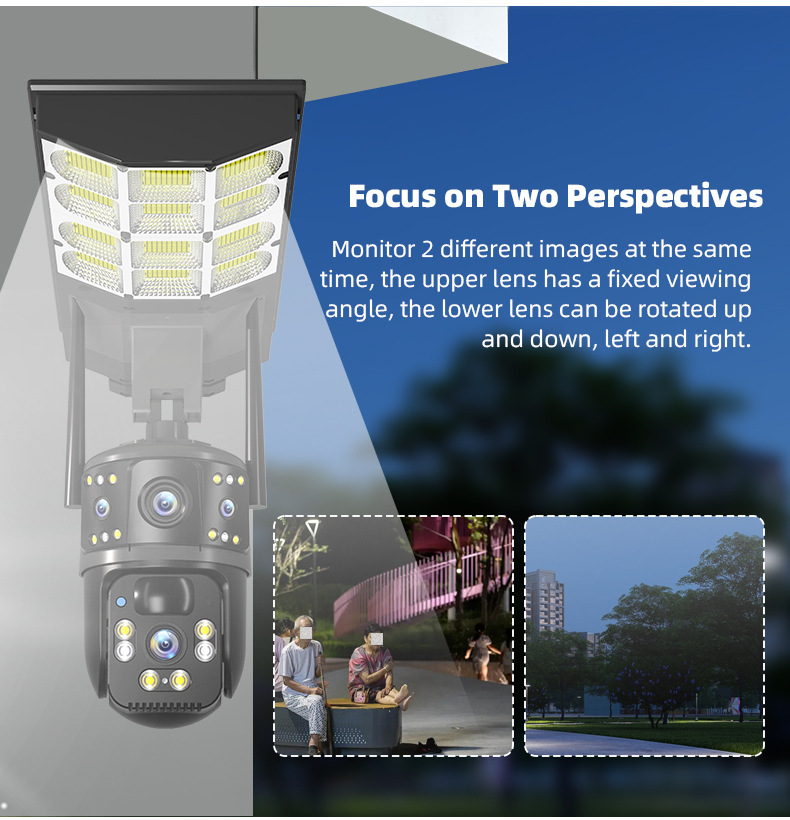
Dual-Perspective Optical Architecture for Simultaneous Area and Target Monitoring

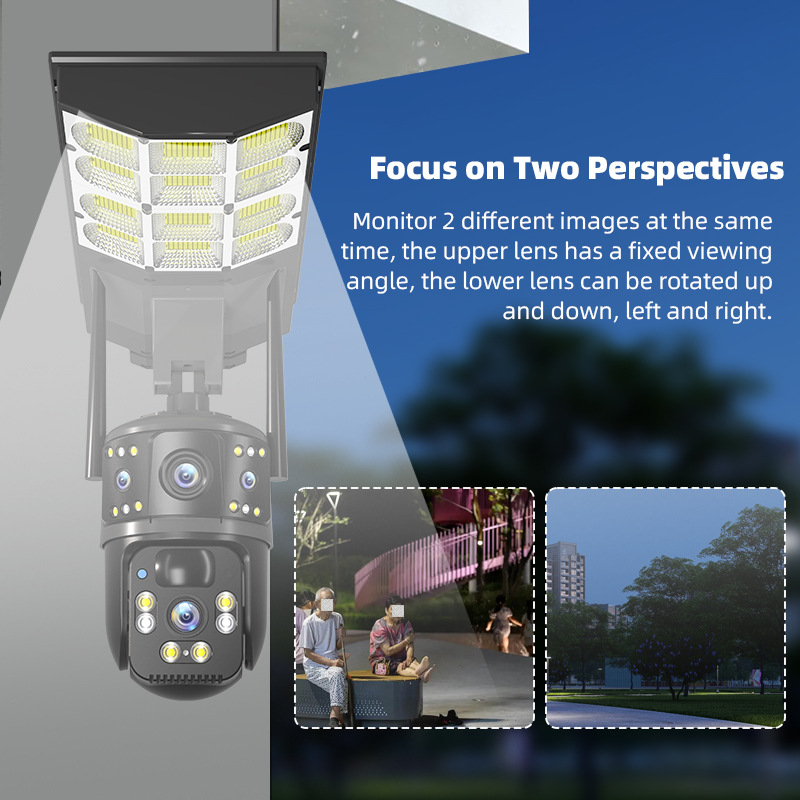
This dual-perspective optical architecture is engineered to separate continuous area awareness from active target inspection within a single solar street light camera system, eliminating the coverage trade-offs inherent in single-lens deployments. The upper lens is fixed at a stable viewing angle to maintain uninterrupted monitoring of the surrounding environment, while the lower lens provides motorized pan and tilt capability to dynamically track movement across horizontal and vertical axes. This structural separation is essential in public streets, residential compounds, and open-access areas where background context must remain visible even when attention shifts to a specific person or event. By decoupling fixed-scene observation from controllable close-range inspection, the system preserves situational continuity during tracking actions and reduces blind intervals that typically occur when a single lens reorients, enabling reliable dual-layer monitoring under autonomous, off-grid operating conditions.

Dual-camera solar street light system demonstrating fixed upper lens and rotatable lower lens for multi-angle outdoor surveillance in off-grid urban environments
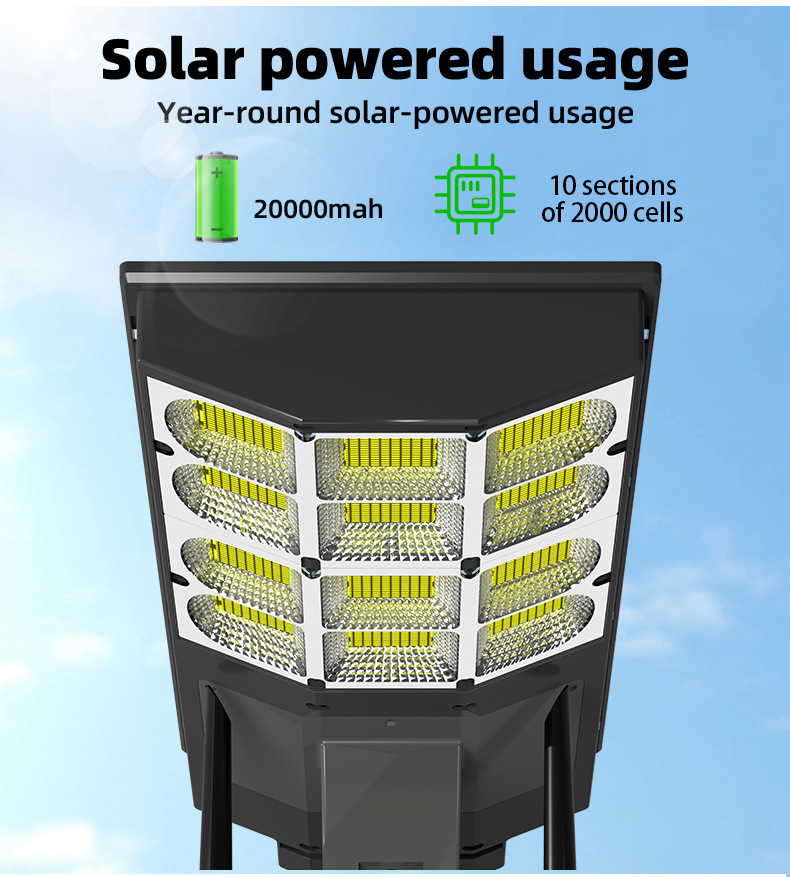
Solar-powered LED street light camera with integrated battery system designed for continuous off-grid surveillance and lighting in outdoor environments

Integrated Energy Architecture for Year-Round Autonomous Operation

This integrated energy architecture is designed to sustain continuous operation in solar street light surveillance deployments where grid power is unavailable or unreliable. The system combines a built-in 20000 mAh battery array composed of multiple segmented cells with direct solar charging to stabilize energy availability across seasonal light fluctuations. This multi-section battery configuration is essential in outdoor public lighting environments, as it distributes charge and discharge loads to reduce stress on individual cells and maintain consistent output during extended overcast periods. By pairing segmented energy storage with daytime solar harvesting, the architecture supports uninterrupted night-time lighting and surveillance functions without manual intervention, making it suitable for long-term deployment in streets, residential access roads, and remote community areas that require autonomous, low-maintenance operation.

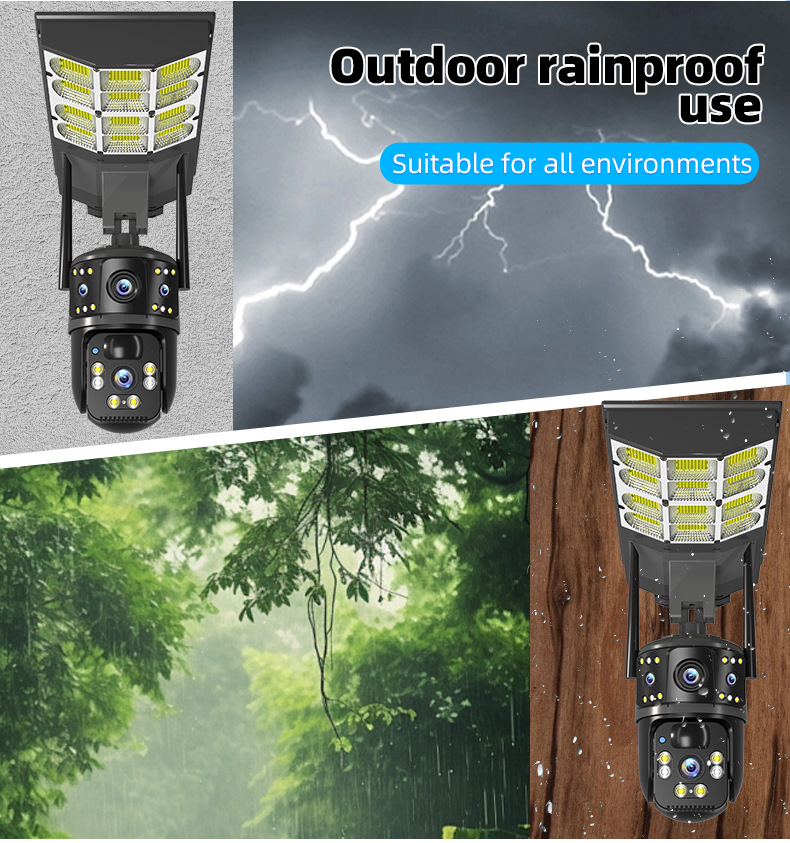
All-Weather Structural Protection for Unattended Outdoor Deployment

This all-weather protection design defines the environmental operating boundary of a dual-lens solar street light camera deployed in open, unattended outdoor locations. The enclosure, sealing interfaces, and external mounting structure are engineered to maintain stable operation under sustained rainfall, high humidity, and rapid weather transitions that commonly affect roadside, rural, and coastal installations. This level of rainproof and environmental protection is critical in regions where continuous exposure to moisture, temperature variation, and airborne particles would otherwise accelerate corrosion, compromise optical components, or destabilize internal electronics. By establishing a controlled internal environment independent of external weather conditions, the system supports long-term lighting and surveillance performance without seasonal intervention, making it suitable for year-round deployment across diverse climates and infrastructure conditions.

Solar-powered LED streetlight with dual-camera surveillance installed outdoors, demonstrating rainproof design and all-weather operation suitability for security monitoring in Southeast Asia and Africa
Solar-powered dual-camera LED streetlight enabling multi-user remote viewing and shared access for residential and community security monitoring applications

Multi-User Access Architecture for Distributed Remote Oversight

This multi-user viewing architecture defines how a dual-lens solar street light camera supports shared, real-time access across multiple authorized users without compromising stream stability or operational control. The system is engineered to allow simultaneous viewing and interaction from different mobile endpoints, enabling family members, property managers, or remote stakeholders to monitor the same location in parallel. This capability becomes essential in residential compounds, shared properties, and unattended outdoor sites where situational awareness must be distributed rather than centralized. By maintaining synchronized video delivery and communication across users, the architecture ensures that alerts, visual context, and response decisions remain consistent, even when access is shared across locations and time zones.

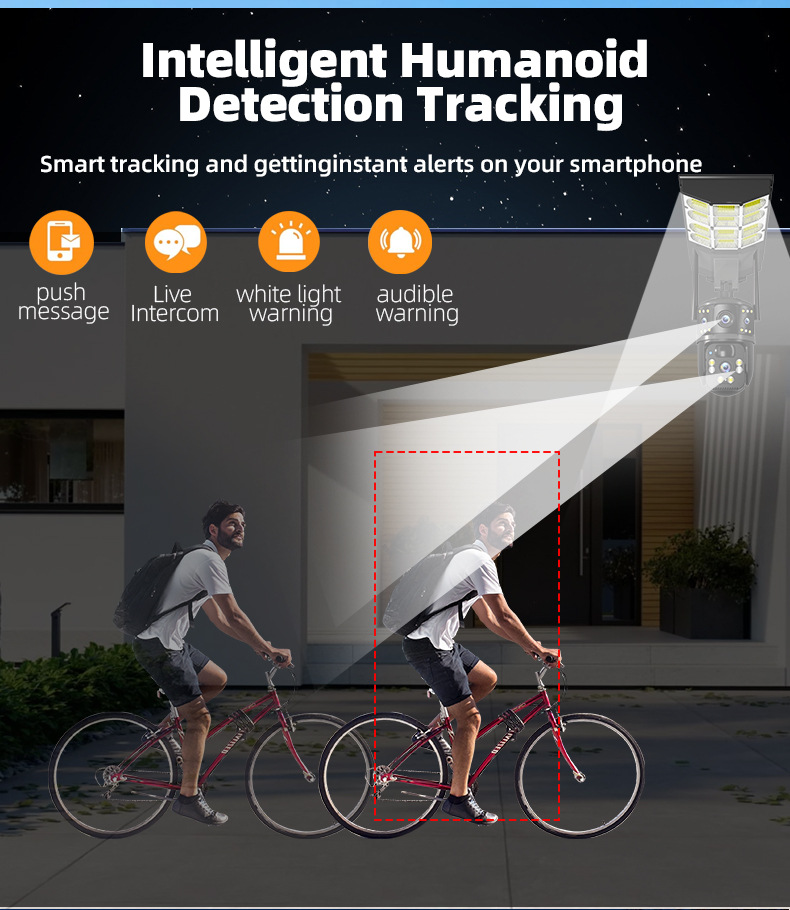
Humanoid Detection and Event-Driven Tracking Architecture

This humanoid detection and tracking architecture defines how the solar-powered dual-lens street light camera differentiates human movement from background motion and initiates event-driven responses in real time. Instead of relying on continuous recording or generic motion triggers, the system applies human-shape recognition to identify valid targets and activate contextual actions only when human presence is confirmed. Once a subject enters the detection zone, tracking logic coordinates visual follow-up with alert mechanisms, including mobile push notifications, live audio interaction, visible white-light deterrence, and audible warnings. This architecture reduces false alarms caused by environmental motion while enabling immediate situational awareness and response, making it suitable for residential perimeters, pathways, and unattended outdoor spaces where proactive intervention is required rather than passive recording.

Solar-powered LED streetlight with dual-camera surveillance performing intelligent humanoid detection and tracking for proactive outdoor security monitoring
Solar-powered LED streetlight with dual-camera PTZ surveillance showing mobile phone remote rotation control for outdoor security monitoring in Southeast Asia and Africa

Remote PTZ Control and Active Coverage Architecture

This remote PTZ control architecture defines how the lower lens of the dual-camera solar street light system enables active, operator-driven coverage rather than fixed or purely automated viewing. Through mobile device control, the camera can rotate horizontally up to 355 degrees and vertically up to 90 degrees, allowing users to manually inspect blind zones, follow developing situations, or reposition the viewing angle in response to real-time observations. This capability complements automated detection by restoring human decision-making into the surveillance loop, particularly in scenarios where situational context cannot be fully resolved through algorithmic triggers alone. By combining remote pan-tilt control with solar-powered autonomy, the system supports comprehensive area oversight without requiring physical repositioning or on-site intervention, making it suitable for residential compounds, access roads, courtyards, and decentralized outdoor installations.

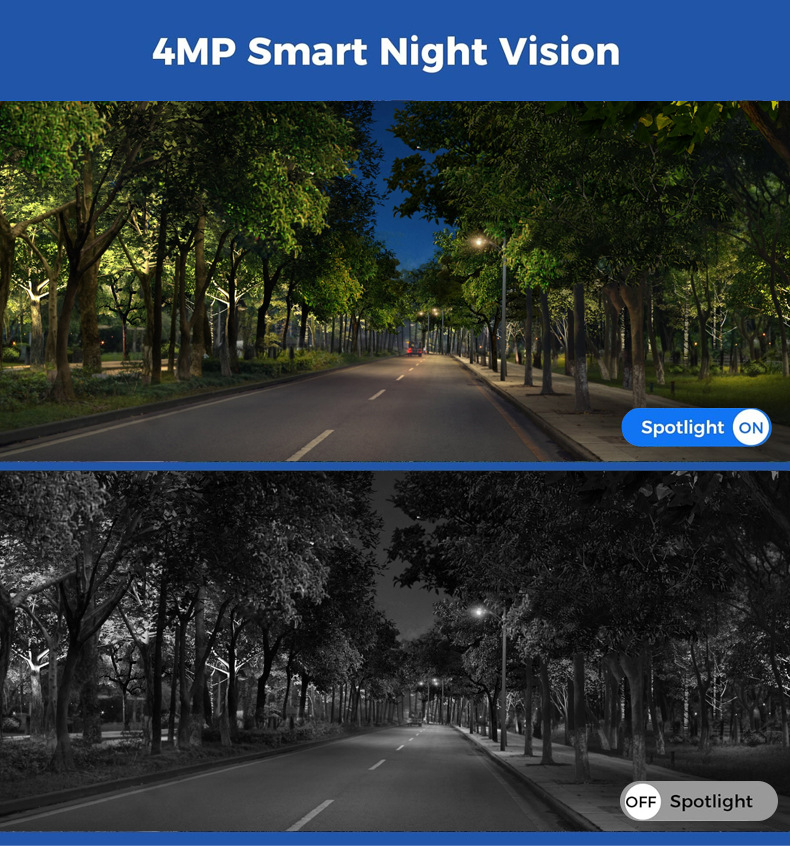
4MP Smart Night Vision and Adaptive Illumination Architecture

This smart night vision architecture illustrates how the dual-lens solar street light camera maintains usable visual intelligence under low-light and zero-light conditions without relying solely on passive infrared imaging. The system combines a 4MP imaging sensor with an adaptive white-light spotlight that can be selectively activated to restore color detail, depth perception, and object recognition accuracy at night. When the spotlight is enabled, the camera transitions from monochrome infrared imaging to full-color night footage, allowing operators to identify environmental context, road conditions, and human or vehicle features that would otherwise be lost in grayscale scenes. This adaptive illumination strategy balances visibility, energy consumption, and deterrence by enabling light output only when visual clarity is operationally required, making it suitable for roads, pathways, residential streets, and perimeter areas where night-time awareness must remain actionable rather than merely detectable.

4MP smart night vision comparison of a solar-powered streetlight camera showing spotlight ON and OFF modes for outdoor road surveillance in off-grid regions
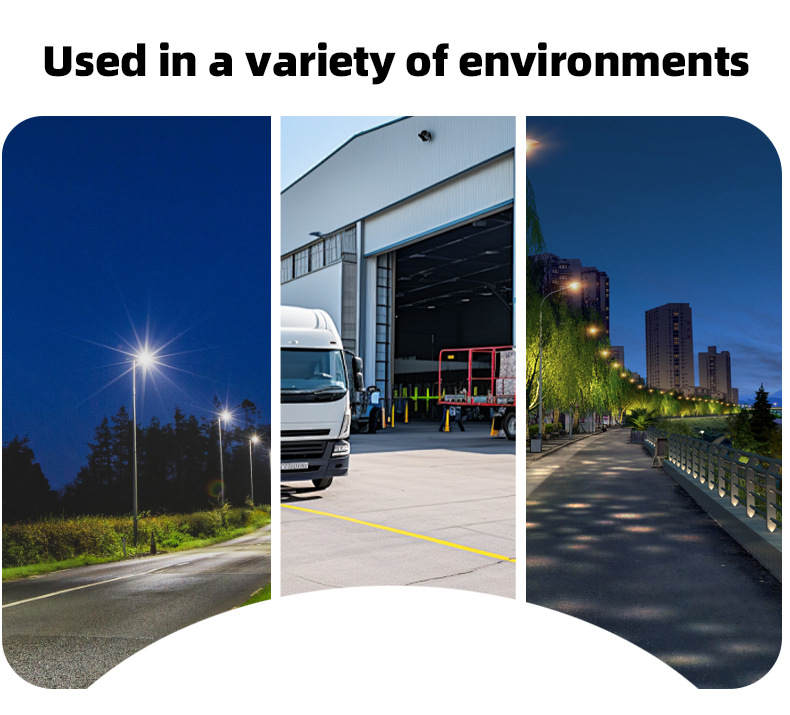
Solar-powered streetlight camera system deployed across roads, industrial zones, and urban outdoor environments for off-grid security monitoring

Multi-Environment Deployment Architecture for Solar Street Light Camera Systems

This image demonstrates how the dual-lens solar street light camera system is engineered for deployment across diverse outdoor environments without requiring site-specific redesign. By integrating lighting, surveillance, power generation, and wireless connectivity into a single pole-mounted architecture, the system can be deployed along roadways, logistics facilities, and urban pedestrian zones where grid power availability, lighting infrastructure, and security requirements vary significantly. The unified design allows consistent illumination coverage, stable camera positioning, and continuous monitoring performance regardless of whether the installation environment is an open road, an industrial loading area, or a residential walkway. This adaptability reduces engineering complexity, shortens deployment cycles, and enables standardized operation and maintenance strategies across mixed-use environments, making the system suitable for scalable municipal, commercial, and infrastructure-level installations.

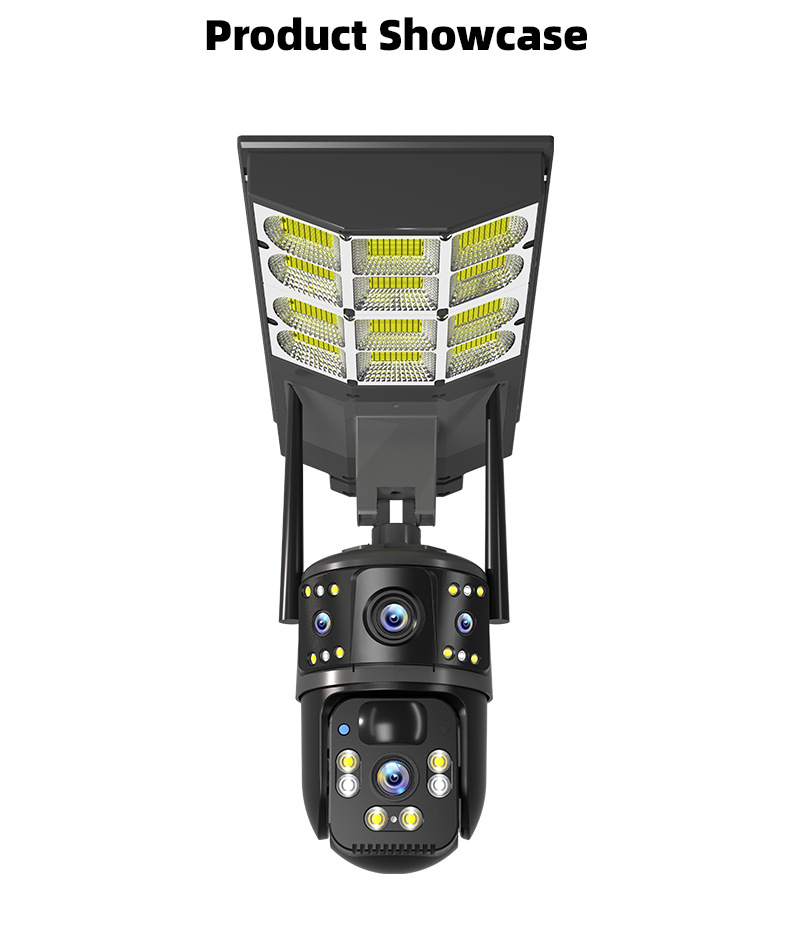
Integrated Dual-Lens Solar Street Light Camera Hardware Architecture

This image presents the complete hardware architecture of the dual-lens solar street light camera system, combining solar energy generation, high-efficiency LED illumination, and multi-angle video surveillance into a single pole-mounted unit. The integrated design unifies the lighting module, power management structure, and dual-camera assembly into a compact vertical form factor that supports continuous outdoor operation without reliance on external grid power. By consolidating illumination and surveillance functions within one mechanical housing, the system minimizes installation complexity, reduces cabling requirements, and ensures stable camera alignment relative to the illuminated area. This all-in-one architecture is engineered for long-term deployment in public infrastructure, residential streets, and commercial environments where reliability, energy autonomy, and simplified maintenance are critical system requirements.
Solar-powered LED streetlight with integrated dual-camera surveillance unit shown as a complete product structure for outdoor security and lighting deployment in Southeast Asia and Africa

For more application scenarios,
please contact customer service

Solar-Powered LED Street Light with Integrated Dual-Camera Surveillance

Subscribe to the latest news of kongfar technology

I agree to receive emails about product and service updates in accordance with the Privacy Policy