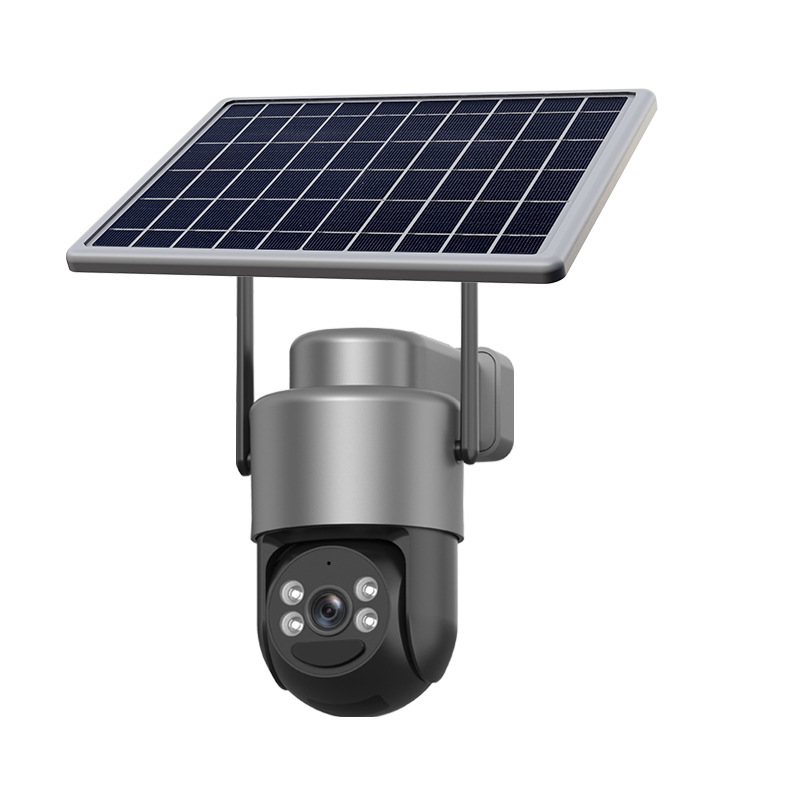
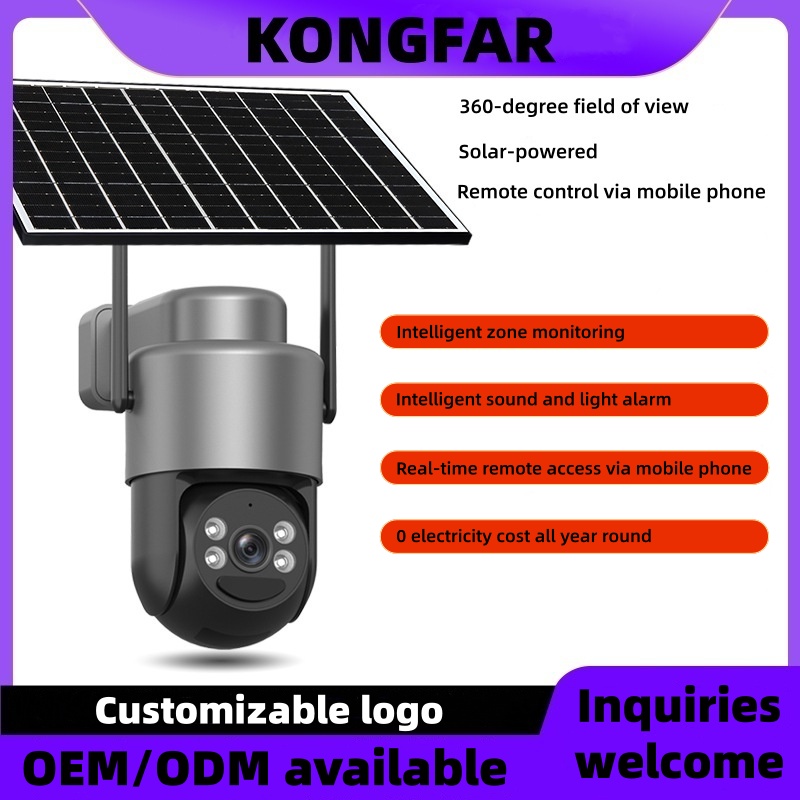
Solar-Powered PTZ Surveillance Camera for Off-Grid Outdoor Monitoring

Description

Single-Point Wide-Angle Monitoring for Distributed Outdoor Sites


* Lens Specifications: 4mm;
* Wide Angle: 120°;
* Resolution: Main stream: 2560*1440, Sub stream: 800*896;
* Video Storage: Supports TF card (32~256G) video storage;
* Voice Intercom: Supports two-way voice intercom;
* Night Vision Mode: Supports 2 adjustable night vision modes (infrared mode/full-color mode);
* PTZ Rotation: PTZ supports 355° left and right rotation, and 90° up and down rotation;
* Application Software: Supports iOS and Android;
* PIR Detection Range: PIR range 10 meters, 120 degrees;
* Solar Panel Power: 7.5W;
* Charging Interface: 5V Type-C interface;
* Battery Capacity: 6000mAh;
* Package Contents: Camera, 7.5W solar panel, solar panel bracket, instruction manual, screw pack;
* Package Dimensions: 260*190*125MM;
* Single Unit Weight: 1.3kg.
Solar-Powered PTZ Surveillance Camera for Off-Grid Outdoor Monitoring

Product Details


Solar-Powered PTZ Surveillance Camera for Off-Grid Outdoor Monitoring


Engineering Conclusion


This solar-powered PTZ surveillance camera is engineered for off-grid outdoor monitoring scenarios where wide-area situational awareness, flexible viewing direction, and remote operation are required without reliance on stable grid power.
System suitability is determined by coverage adaptability, event-driven repositioning, and energy-aware operation, rather than by resolution or nominal motor specifications.

Engineering Problem This System Addresses


In many outdoor monitoring environments, surveillance requirements are not confined to a fixed viewing direction.
Events may occur across wide or changing areas, making static camera coverage insufficient or inefficient.

Traditional grid-powered PTZ systems solve this through mechanical repositioning, but off-grid environments introduce constraints related to energy availability, maintenance access, and deployment flexibility.

This system addresses the gap by combining solar energy autonomy with PTZ functionality, enabling controlled directional coverage without grid dependency.

System Architecture Overview


The system integrates photovoltaic generation, onboard energy storage, PTZ camera hardware, and remote control logic into a unified off-grid surveillance platform.
Solar power generation and energy storage are sized to support intermittent mechanical movement rather than continuous motion, aligning PTZ behavior with real-world energy availability.

Remote connectivity enables directional control, preset positioning, and event-driven repositioning without physical site access.

Why PTZ Architecture Matters in Off-Grid Surveillance


PTZ architecture enables selective, wide-area visual inspection without requiring multiple fixed cameras.
Instead of continuous multi-directional presence, PTZ systems provide adaptive coverage, focusing attention where events or anomalies are detected.

In off-grid deployments, this approach can reduce overall optical channel count while maintaining operational flexibility—provided that mechanical movement is managed within energy constraints.

Engineering Boundary Conditions & Design Assumptions


System performance and suitability are defined under the following engineering boundary conditions:
✅ Grid Power Absence
Designed for locations without stable grid access or where grid extension introduces unacceptable cost or reliability risk.

✅ Solar Energy Variability
PTZ movement frequency is assumed to be intermittent rather than continuous, aligned with realistic solar generation patterns.

✅ Event-Driven Repositioning
System effectiveness assumes PTZ motion is triggered by operational need, not constant patrol cycles.

✅ Environmental Exposure
Engineered for outdoor deployment under wind, dust, rainfall, and temperature variability typical of remote monitoring sites.

✅ Limited Maintenance Access
Optimized for scenarios where on-site maintenance is infrequent and system autonomy is essential.

Decision-Relevant Parameters


The following parameters are presented as engineering decision drivers, not isolated specifications:

PTZ Movement Duty Cycle


Mechanical motion frequency directly impacts energy consumption and long-term reliability, making duty-cycle control critical.

Energy Storage Capacity


Battery sizing determines how many repositioning events can occur during extended low-generation periods.

Remote Control Logic


Preset positioning and remote commands reduce unnecessary motion while preserving response flexibility.

Integrated Solar Power Architecture


Shared power management ensures PTZ operation does not compromise baseline system availability.

Engineering Decision Rationale


From an engineering perspective, PTZ architecture is selected when coverage adaptability outweighs the need for constant multi-directional presence:
✅ One camera covers multiple observation zones
✅ Mechanical motion replaces multiple fixed installations
✅ Event-driven control limits energy and wear impact
✅ Solar autonomy enables deployment where grid systems fail

Engineering Decision Q&A


Under what conditions is a solar-powered PTZ surveillance system the correct engineering choice?


A solar-powered PTZ surveillance system is appropriate when monitoring requirements span multiple directions or zones and when fixed-camera coverage would require excessive hardware duplication.
It is best suited for sites where events are intermittent and directional focus can be adjusted based on operational need.

How does PTZ architecture differ from fixed-camera systems in off-grid environments?


PTZ architecture replaces continuous multi-directional presence with controlled mechanical repositioning.
This reduces camera count but introduces energy and mechanical considerations that must be managed through duty-cycle control.

Why is intermittent PTZ movement critical in solar-powered deployments?


In solar-powered systems, continuous PTZ motion can rapidly deplete energy reserves.
Engineering design therefore limits motion frequency and prioritizes stationary monitoring between repositioning events.

How does energy autonomy influence PTZ system behavior?


Energy autonomy determines how frequently and how far the camera can reposition during extended low-irradiance periods.
Systems dynamically balance motion capability against baseline monitoring continuity.

Under what conditions does PTZ functionality become constrained?


PTZ functionality becomes constrained when prolonged low solar generation coincides with high repositioning demand.
In such cases, systems maintain fixed observation until energy recovery occurs.

Is a solar-powered PTZ system suitable for permanent unattended deployment?


Yes, provided PTZ movement is event-driven and aligned with energy availability assumptions.
Under these conditions, long-term unattended operation is achievable without grid dependency.

When does PTZ offer limited engineering advantage in off-grid monitoring?


PTZ offers limited advantage when monitoring requirements are confined to a single, predictable viewing direction.
In such scenarios, fixed-camera or multi-lens architectures may deliver equivalent outcomes with lower mechanical complexity.

Engineering Takeaway


This solar-powered PTZ surveillance camera should be evaluated as an adaptive coverage solution, not as a constant-motion system.
Its engineering value lies in how effectively it balances directional flexibility, mechanical reliability, and solar energy constraints in real-world off-grid deployments.


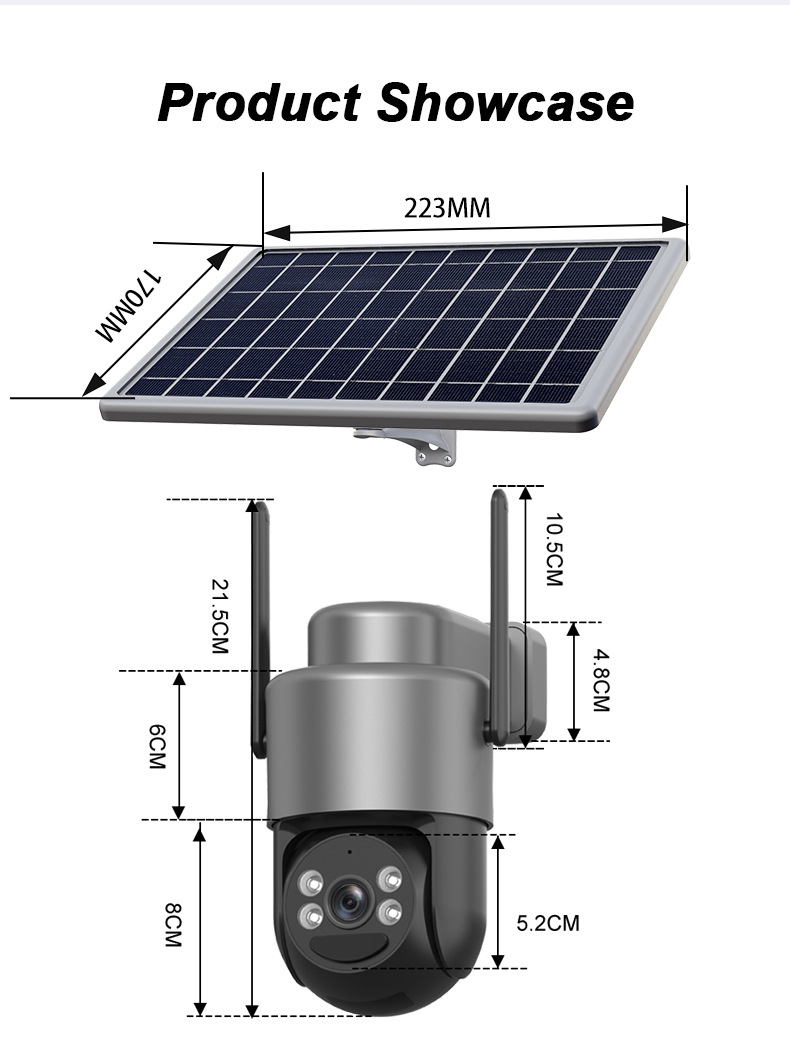
Product Structure

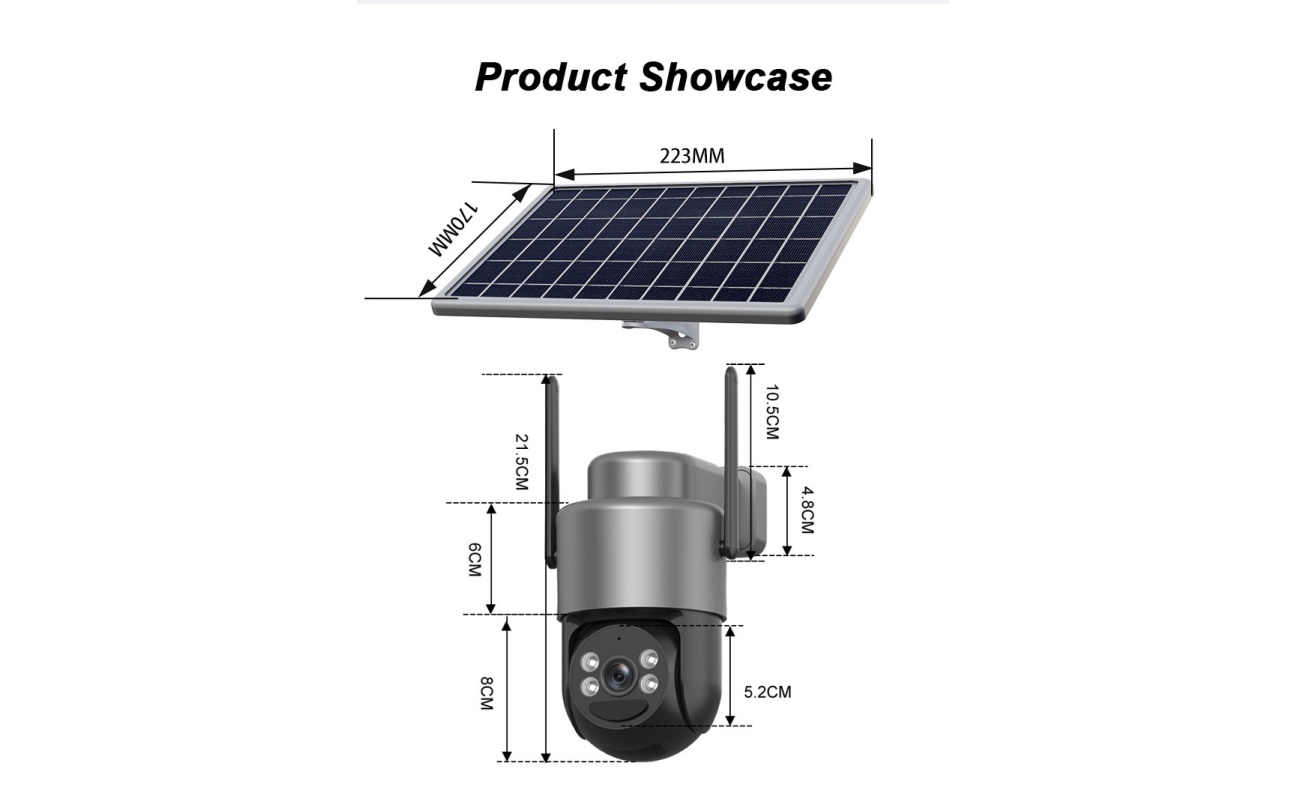
Dimension and structure diagram of a solar powered PTZ security camera showing panel size, mounting height, and camera body measurements for off-grid surveillance projects
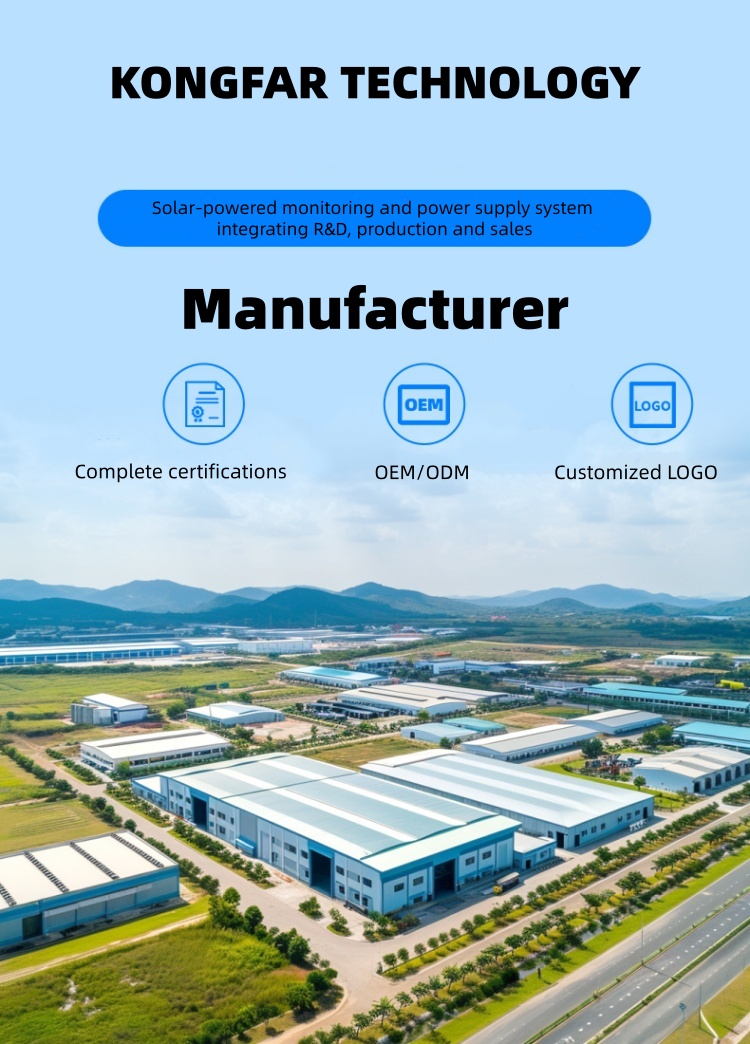
Aerial view of a solar security camera manufacturing facility showing integrated R&D, production, and OEM ODM capabilities for solar-powered monitoring systems

Manufacturer-Level Integration for Solar-Powered Monitoring Systems


This product is backed by Shenzhen Kongfar Technology Co., Ltd., a manufacturer specializing in solar-powered monitoring and power supply systems with integrated R&D, production, and global delivery capabilities.
Unlike trading-based supply models, Kongfar operates a vertically integrated manufacturing framework that controls system design, component selection, assembly, testing, and OEM/ODM execution under one roof.


The manufacturing base supports projects requiring off-grid solar surveillance equipment for infrastructure, agriculture, energy, and remote-area security deployments across multiple regions, including North America, Europe, Australia, and emerging off-grid markets.
This structure ensures compliance alignment, stable lead times, and consistent system performance across varied environmental and regulatory conditions.


With complete certifications, OEM/ODM customization pathways, and brand-level logo integration, the factory setup is designed to support B2B procurement, system integrators, and project-based buyers seeking long-term supply continuity rather than one-off devices.

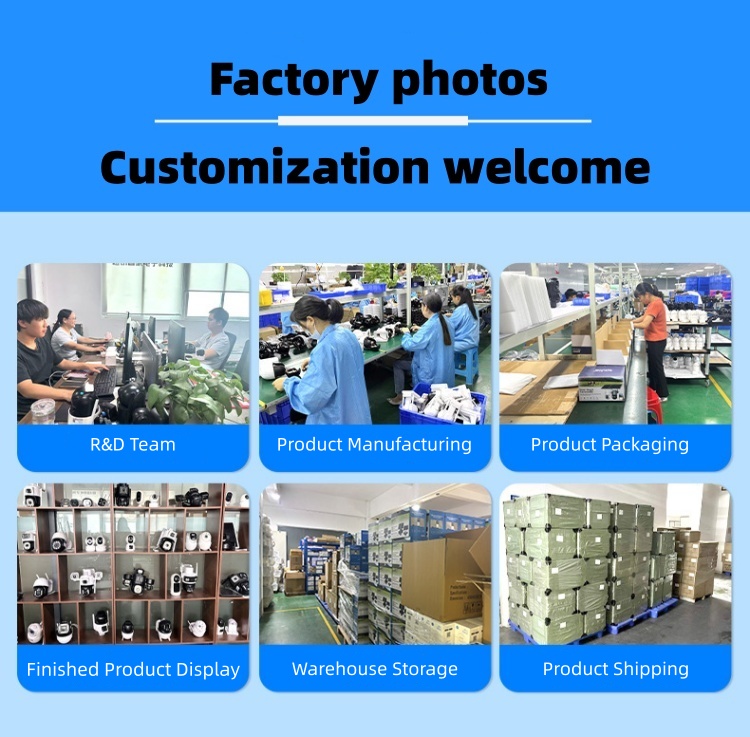
End-to-End Manufacturing Workflow for Solar-Powered Surveillance Systems


This system is supported by a full-cycle manufacturing workflow, covering R&D engineering, component assembly, system integration, packaging, warehousing, and outbound logistics.
Each stage operates within a controlled production environment to ensure consistency, traceability, and repeatability for solar-powered surveillance systems supplied to project-based and OEM customers.


The in-house R&D team focuses on system architecture, power matching, and environmental adaptability, while dedicated production lines handle device assembly and functional testing under standardized procedures.
Finished units undergo structured packaging and inventory management, enabling stable delivery for batch orders, customized configurations, and long-term supply agreements.


This manufacturing structure is designed to support OEM/ODM customization, regional compliance requirements, and multi-market deployment, providing system integrators and distributors with a reliable production and shipping foundation for off-grid monitoring applications.

Factory photos showing research, manufacturing, packaging, warehouse storage, and shipping processes for solar-powered security cameras
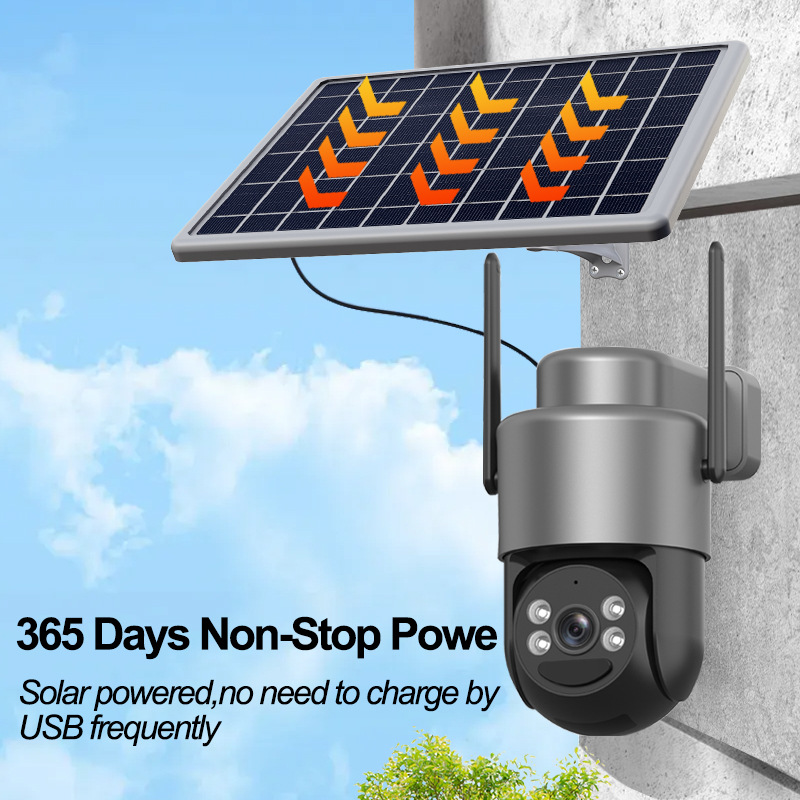
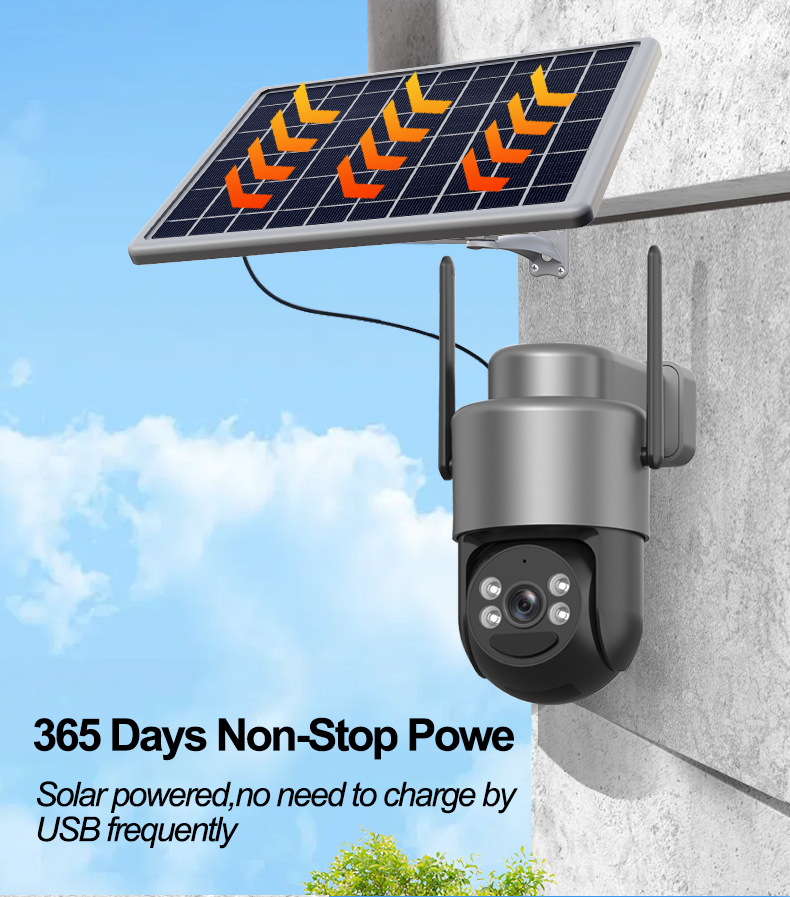
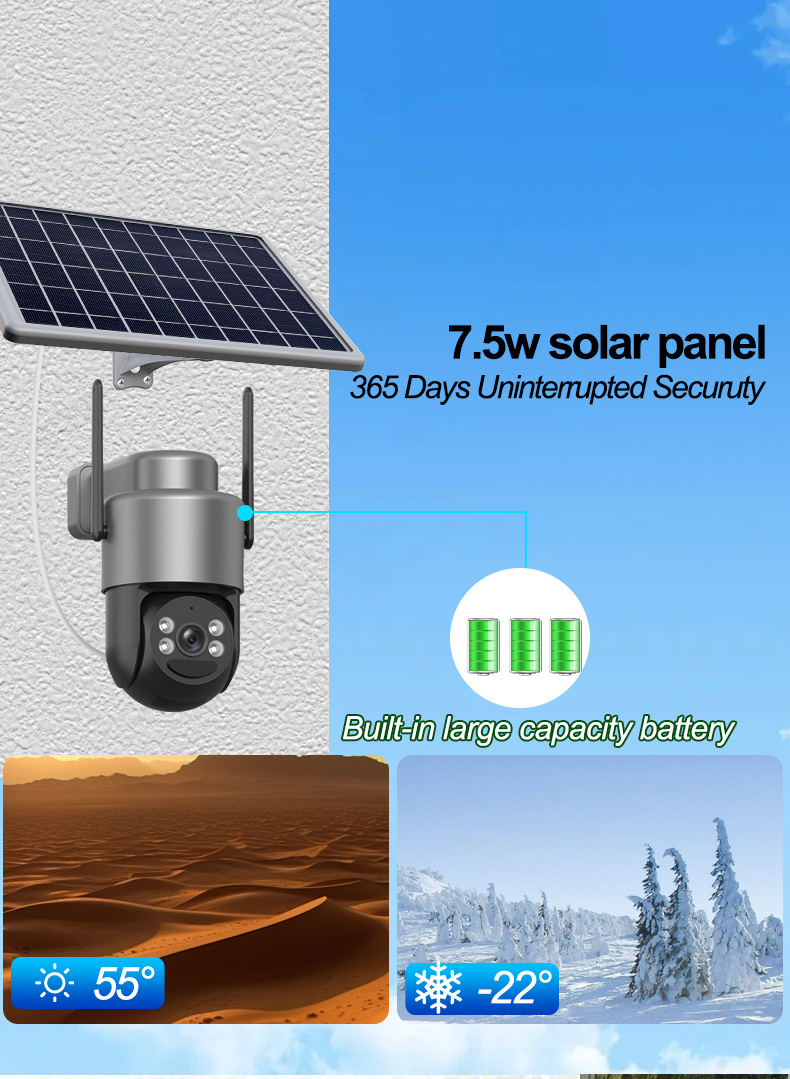
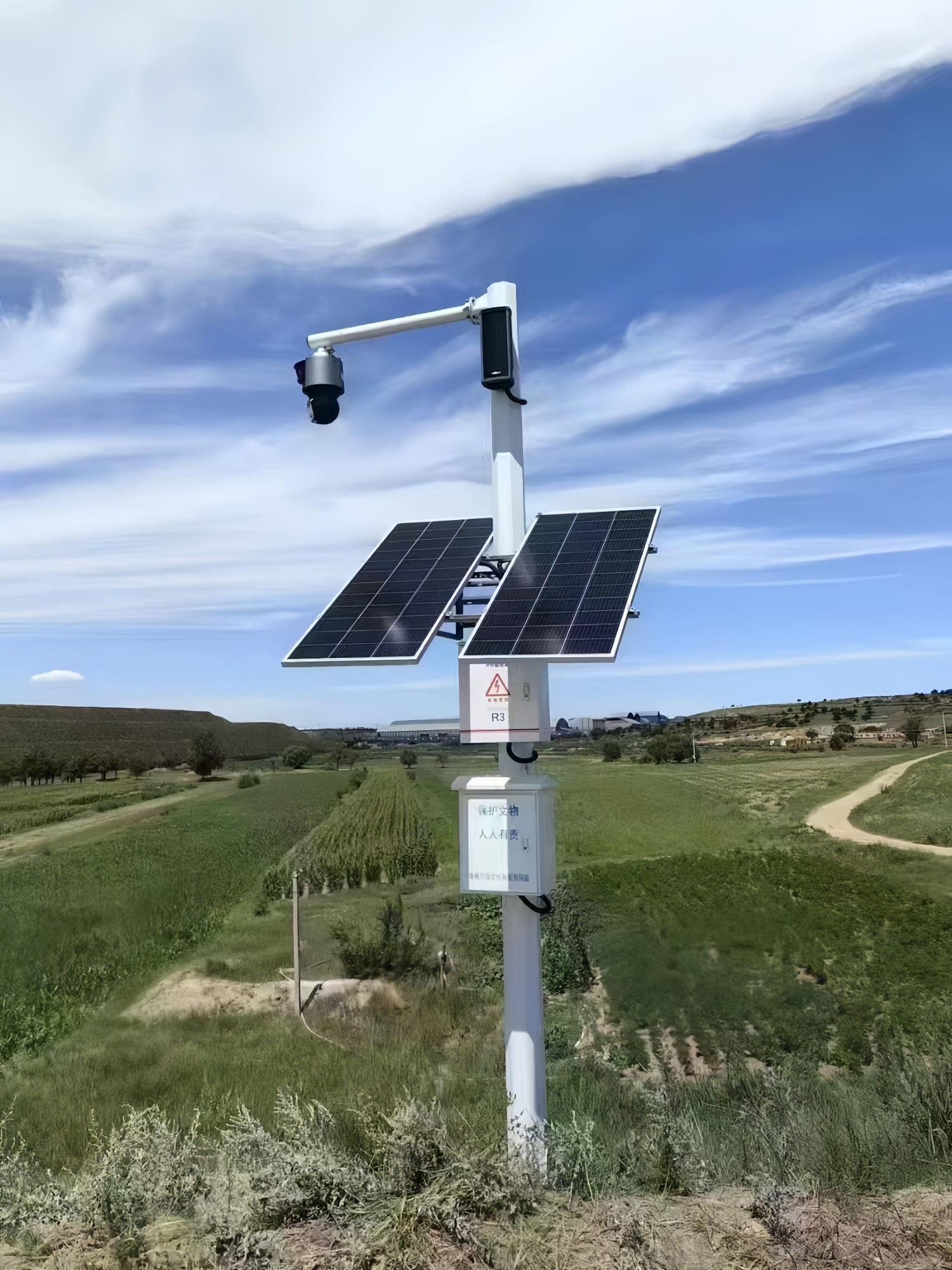
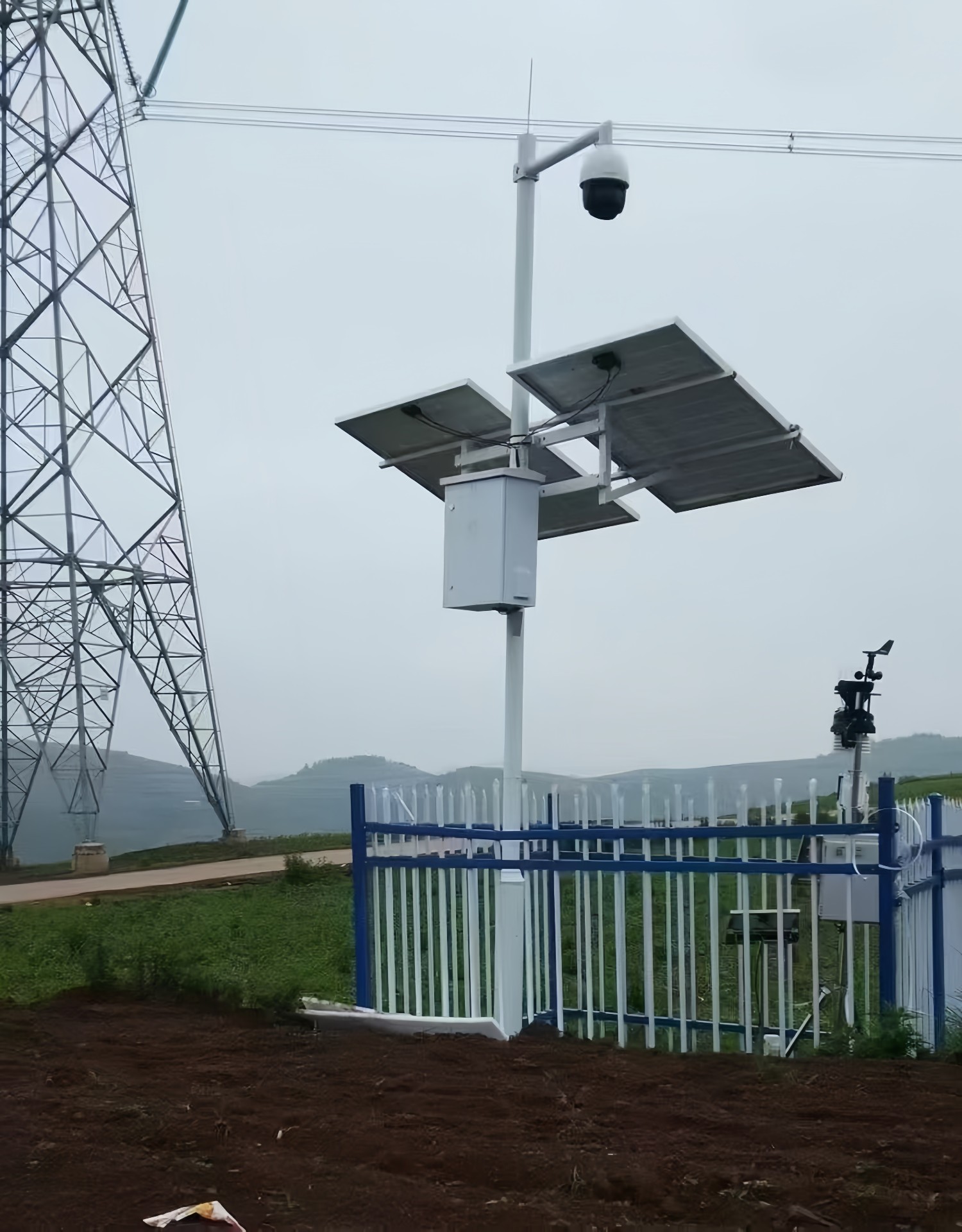
Solar powered PTZ security camera mounted outdoors delivering 365 days non stop power for off grid surveillance applications

Autonomous Solar-Powered PTZ Surveillance Node with Continuous Energy Availability

This image defines an autonomous solar-powered PTZ surveillance node engineered for uninterrupted year-round operation without reliance on grid power or periodic manual charging, where the photovoltaic module, internal energy storage, and motorized imaging subsystem are architecturally coupled to form a closed-loop energy and sensing unit, and the engineering boundary condition is sustained visual monitoring under variable solar input with zero external power intervention, making the system suitable for fixed outdoor deployments that require continuous readiness rather than duty-cycled recording, including perimeter security, rural properties, temporary construction zones, and infrastructure edge locations where USB charging, wired power, or scheduled maintenance cannot be assumed, and where long-term operational stability is achieved through direct solar harvesting matched to the camera’s motion, transmission, and night-vision load profile rather than through oversized batteries or auxiliary power accessories.

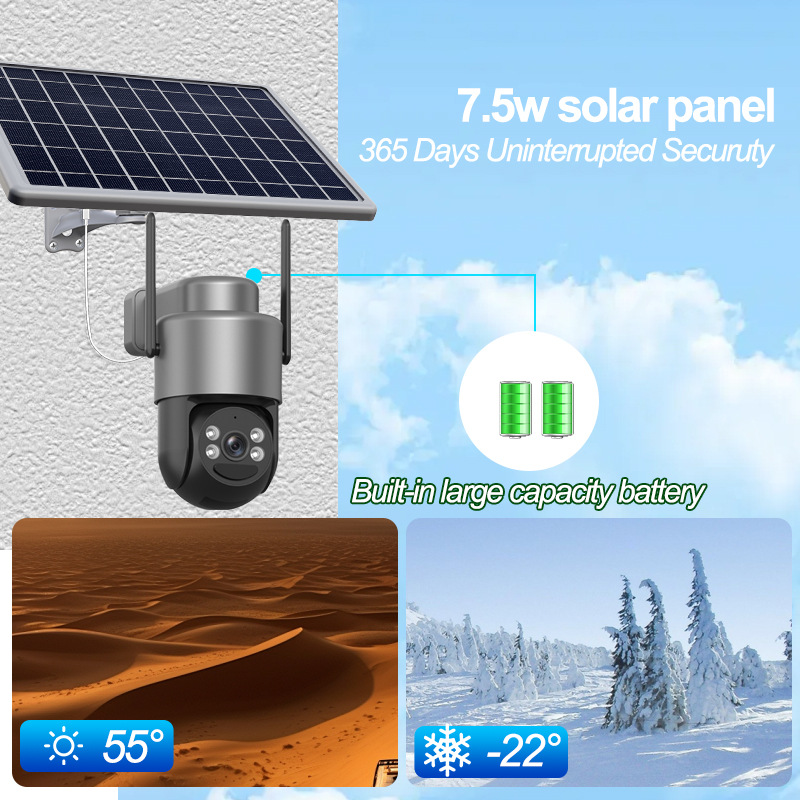
Integrated Solar Energy Module with Temperature-Resilient Storage for Continuous PTZ Operation

This image establishes a solar-powered surveillance subsystem in which a 7.5 W photovoltaic panel and a built-in large-capacity battery are engineered as a single energy domain to guarantee uninterrupted camera operation across extreme ambient temperatures, defining an engineering boundary condition of sustained power availability from approximately –22 °C cold environments to +55 °C high-heat regions, where energy generation, storage, and discharge behavior must remain stable without user intervention, external charging, or auxiliary power input, and where the system’s design intent is not peak performance under ideal sunlight but energy continuity under real-world seasonal, geographic, and climatic stress, enabling long-term deployment in deserts, high-latitude cold zones, remote infrastructure sites, and unattended outdoor locations where maintenance access is limited and power reliability is a non-negotiable operational requirement rather than an optimization parameter.

Solar powered PTZ camera with 7.5W solar panel and built in battery operating reliably in extreme hot and cold environments
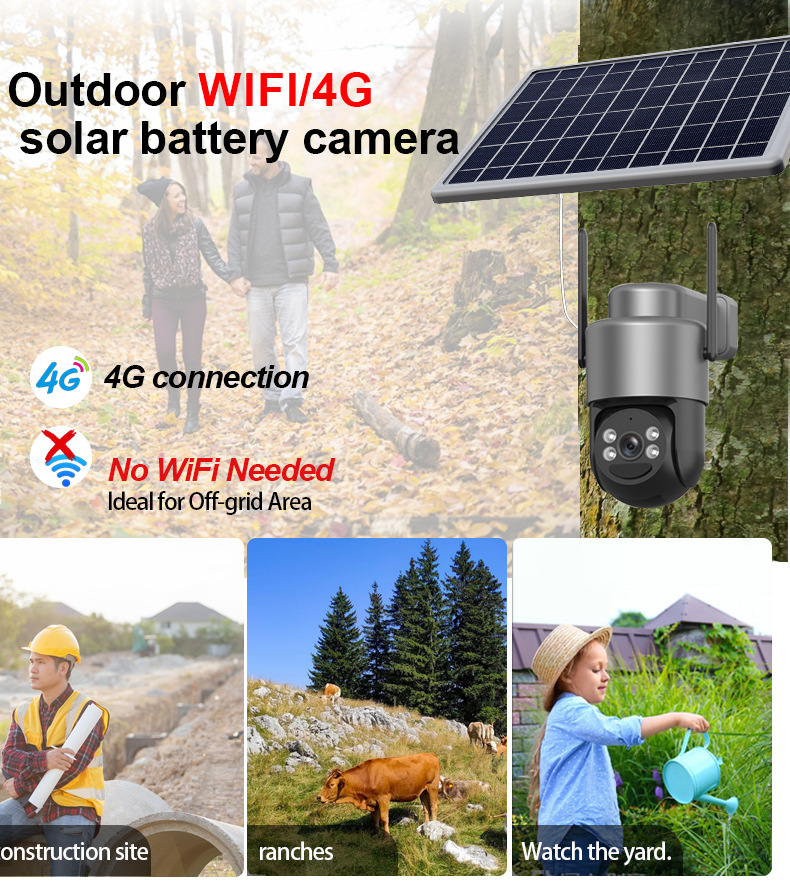
Outdoor 4G solar powered security camera designed for off grid monitoring without WiFi infrastructure

Cellular-First Connectivity Architecture for Off-Grid Solar Surveillance Deployment

This image defines a surveillance system whose primary communication layer is independent of local Wi-Fi infrastructure, operating through integrated 4G cellular connectivity with optional Wi-Fi fallback, establishing an engineering premise that data transmission, remote access, and event notification remain available in environments where fixed broadband is absent, unstable, or economically impractical, such as construction sites, ranches, agricultural land, forest perimeters, and other off-grid or semi-grid locations, where network availability is treated as a variable constraint rather than an assumed condition, and where the system’s value is derived from its ability to sustain autonomous operation by coupling solar energy generation, local battery buffering, and wide-area cellular communication into a single deployment unit, enabling continuous monitoring, alert delivery, and remote management without reliance on on-site routers, cabling, or permanent human presence, thereby transforming connectivity from a deployment limitation into an embedded capability that scales geographically and seasonally without reconfiguration.

Bidirectional Audio Communication Layer for Remote Solar Surveillance Systems

This image defines a surveillance system architecture in which two-way voice intercom is treated as an operational control interface rather than a consumer convenience, integrating a weather-sealed microphone and speaker directly into the solar-powered camera node to enable real-time audio interaction across distance, network latency, and physical separation, allowing operators, homeowners, or site managers to communicate with on-site individuals without being physically present, under conditions where power supply, cabling, and local infrastructure are constrained or unavailable, and where voice transmission is synchronized with live video and event triggers to support deterrence, verification, instruction delivery, and situational response in residential perimeters, remote properties, temporary sites, and unattended facilities, thereby positioning audio communication as a functional extension of remote presence and decision-making rather than a passive monitoring feature.

Solar powered PTZ security camera with built in microphone and speaker enabling two way voice intercom for outdoor monitoring
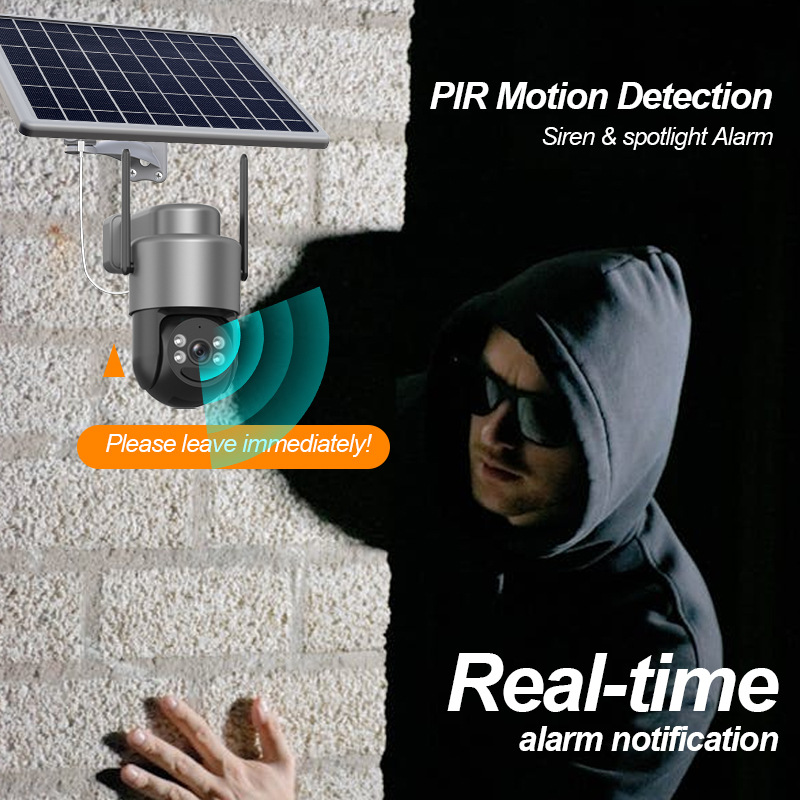
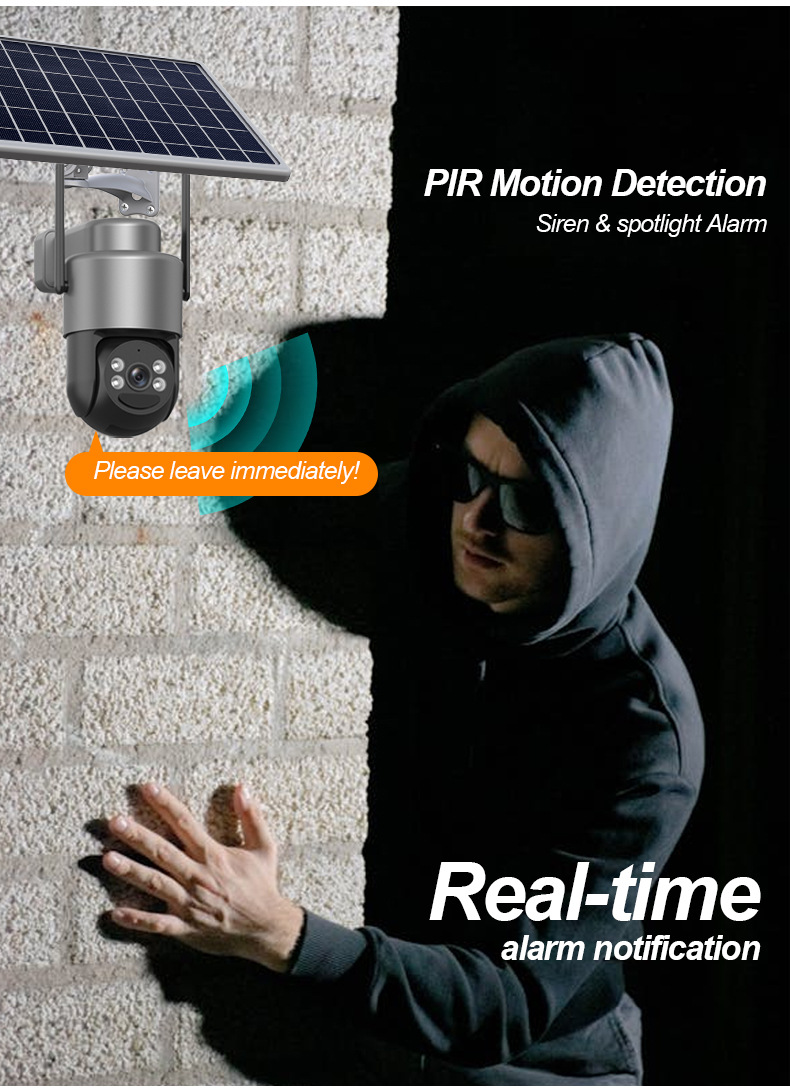
Solar powered CCTV camera using PIR motion detection to activate siren and spotlight alarm for real-time outdoor intrusion warning

PIR-Triggered Active Deterrence and Real-Time Alarm Response Layer

This image defines a solar-powered surveillance system in which PIR motion detection is architected as an active response trigger rather than a passive sensing function, using low-power infrared motion recognition to identify human-scale movement within defined boundary conditions and immediately escalating events through synchronized on-device actions—including audible siren output, high-intensity spotlight activation, and real-time alarm notifications transmitted to remote operators—designed to function autonomously in off-grid or unattended environments where immediate human presence is unavailable, ensuring that detection, deterrence, and alerting occur within a single integrated control loop that reduces response latency, minimizes false engagement, and supports perimeter protection, intrusion prevention, and situational awareness across residential, rural, construction, and temporary security deployments under variable lighting, power, and network constraints.

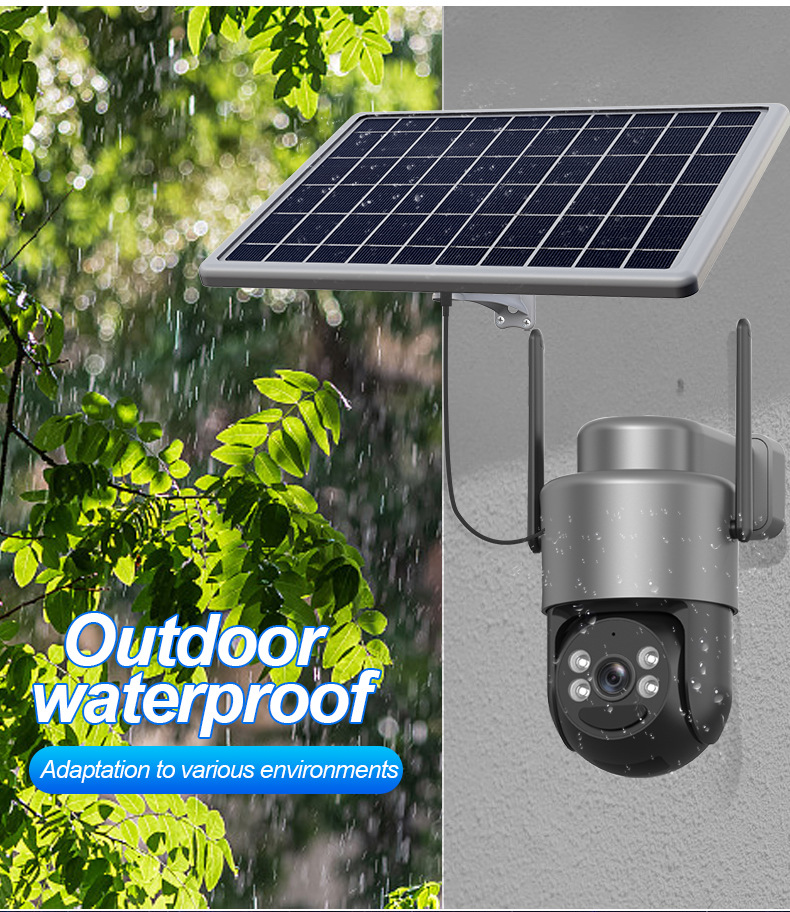
All-Weather Outdoor Environmental Adaptation and Sealed Power-Vision Architecture

This image defines a solar-powered PTZ surveillance system engineered for continuous outdoor deployment under uncontrolled environmental exposure, where the camera body, power intake, and communication modules are structurally sealed and thermally tolerant to maintain operational stability during rain, humidity, dust, and temperature variation, enabling reliable video capture, energy harvesting, and wireless transmission in environments where conventional indoor-rated devices fail, such as open yards, forest edges, agricultural land, construction perimeters, and remote infrastructure sites, with the system’s waterproof enclosure, corrosion-resistant materials, and isolated power-routing design forming a single integrated protection architecture that preserves imaging accuracy, battery health, and network availability without requiring shelters, external housings, or climate-controlled installations.

Outdoor waterproof solar powered CCTV camera operating reliably in rain and harsh weather environments for continuous security monitoring

Solar powered CCTV camera with mobile app remote access and shared viewing for multiple users across different locations

Distributed Remote Access Architecture with Multi-User Authorization Control

This image establishes a solar-powered surveillance system designed around location-independent remote access, where live video, playback, PTZ control, alerts, and audio communication are securely accessible through authenticated mobile clients regardless of geographic distance, network type, or time zone, enabling the system to function as a shared monitoring endpoint rather than a single-user device, with role-based multi-user viewing permissions allowing authorized family members, operators, or stakeholders to simultaneously access the same camera feed without degrading stream stability, command responsiveness, or data integrity, making the system suitable for scenarios that require continuous off-site supervision such as remote residences, distributed assets, agricultural land, construction projects, and unattended facilities, where the camera becomes a persistent networked node that maintains visibility, control continuity, and situational awareness even when no personnel are physically present at the installation site.
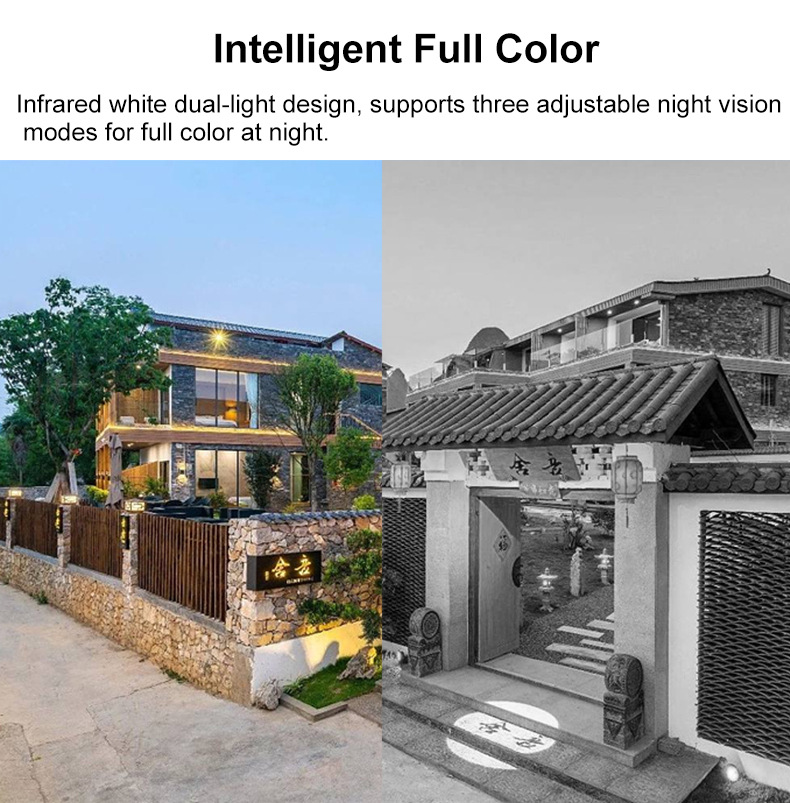
Adaptive Dual-Light Night Imaging Architecture with Mode-Selectable Color Fidelity

This image defines a solar-powered surveillance imaging system built on a dual-light optical architecture that integrates infrared illumination and visible white light sources into a coordinated night-vision control layer, enabling the camera to dynamically switch between grayscale infrared monitoring, hybrid assisted color imaging, and full-color night vision based on ambient light levels, motion events, and user-defined security policies, thereby preserving scene detail, color accuracy, and subject identifiability after sunset without imposing continuous high power draw, where the system maintains low-energy infrared observation as a baseline state and selectively activates visible illumination only when conditions require color-critical evidence capture, ensuring that night surveillance transitions from simple presence detection to legally and operationally usable visual records, particularly in residential perimeters, access points, and outdoor compounds where distinguishing clothing, vehicles, and environmental context at night is a functional requirement rather than a cosmetic feature.

Solar powered CCTV camera showing intelligent full color night vision with infrared and white light illumination for outdoor home security monitoring

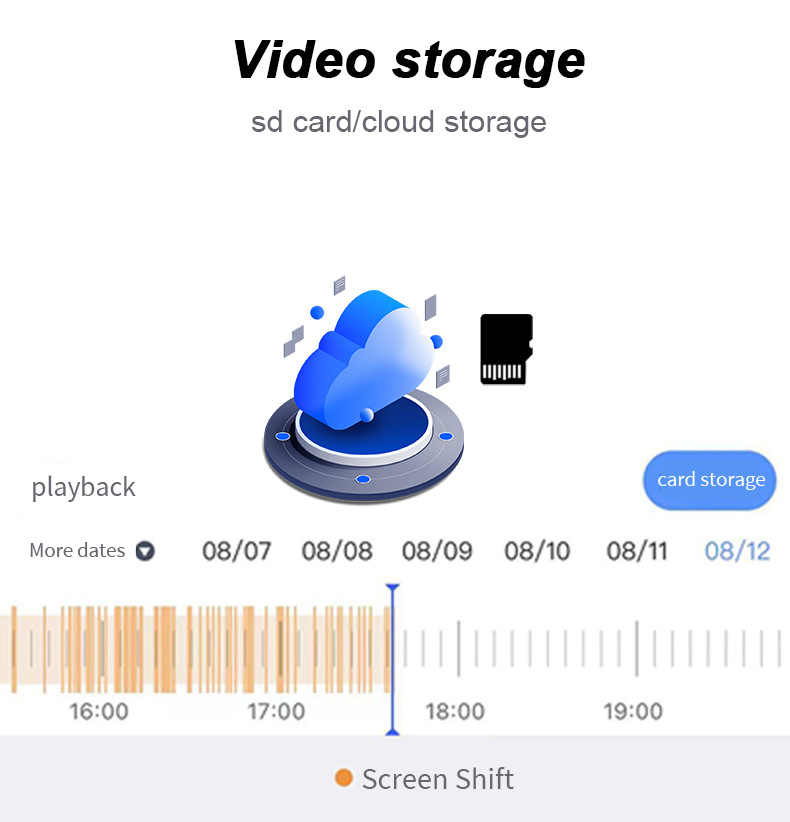
Solar powered security camera video storage interface showing SD card and cloud playback timeline for off grid surveillance applications
Hybrid Edge–Cloud Video Retention Architecture with Event-Indexed Playback Logic

This image defines a dual-layer video storage architecture designed for solar-powered and bandwidth-variable surveillance deployments, where on-device SD card storage functions as the primary edge retention layer for continuous or event-triggered recording while cloud storage operates as a synchronized secondary layer for off-site redundancy, remote access, and long-term evidence preservation, under constraints of intermittent connectivity, limited uplink bandwidth, and power-aware operation, in which recorded video is automatically indexed by time and motion events to enable timeline-based playback, rapid scrubbing, and precise incident retrieval without requiring full video streaming, allowing the system to preserve critical footage locally during network outages and selectively upload priority clips when connectivity is available, making the architecture suitable for residential security, remote properties, construction sites, and off-grid environments where reliability, traceability, and post-event review are required without dependence on continuous cloud availability.
Integrated Dimensional Envelope Definition for Wall-Mounted Solar PTZ Surveillance Nodes

This image defines the physical and spatial envelope of a wall-mounted, solar-powered PTZ surveillance unit engineered for permanent outdoor deployment, where the overall geometry—including a compact camera body, vertically oriented antenna elements, and a top-mounted photovoltaic module with a defined footprint—establishes the installation boundary conditions for façade mounting, pole adjacency, and clearance from architectural obstructions, ensuring predictable load distribution, wind exposure tolerance, and maintenance access under real-world constraints such as limited wall space, uneven surfaces, and mixed materials, while the proportional relationship between the solar panel dimensions and the camera housing guarantees sufficient energy harvesting area without overhang risks, making the system suitable for residential buildings, perimeter walls, construction sites, and remote structures where standardized mounting envelopes, repeatable installation outcomes, and compatibility with existing infrastructure are required for long-term, off-grid surveillance operation.
Dimension and structure diagram of a solar powered security camera showing panel size camera body height and mounting distances for installation planning
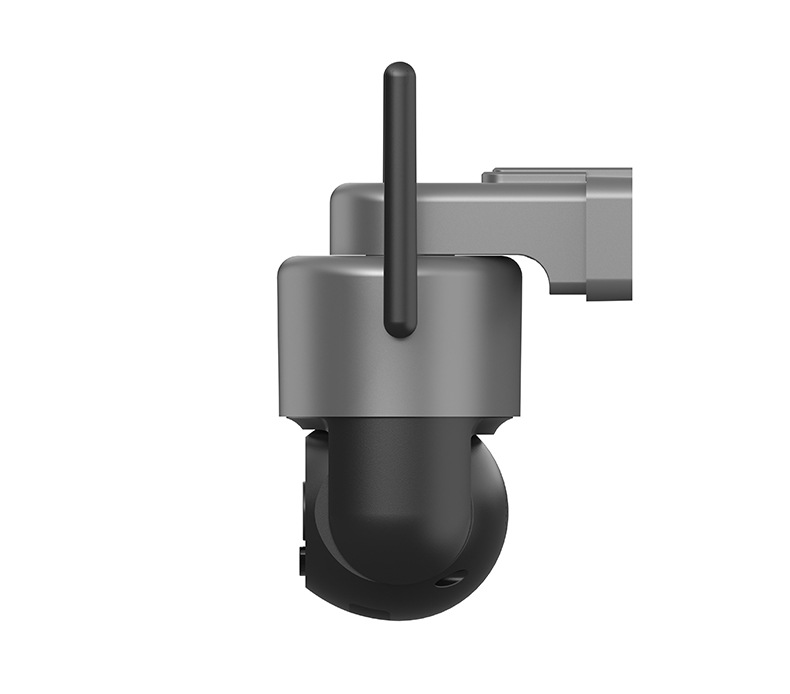
Side view of a wall mounted solar powered security camera showing antenna placement housing design and installation angle for outdoor surveillance
Side-Profile Mounting Geometry Definition for Solar-Powered PTZ Surveillance Units

This image defines the side-profile mechanical and installation geometry of a solar-powered PTZ surveillance unit, illustrating how the vertically stacked camera housing, integrated antenna orientation, and rear-anchored mounting arm establish a controlled offset from the mounting surface to preserve pan-tilt clearance, signal propagation efficiency, and thermal airflow, while maintaining a compact projection depth that minimizes visual intrusion and wind load, making the system suitable for wall-mounted deployments on residential façades, boundary walls, utility structures, and light industrial buildings where predictable rotation envelopes, antenna line-of-sight stability, and long-term mechanical alignment are required under outdoor conditions without grid power access.

For more application scenarios,
please contact customer service

Solar-Powered PTZ Surveillance Camera for Off-Grid Outdoor Monitoring

Subscribe to the latest news of kongfar technology

I agree to receive emails about product and service updates in accordance with the Privacy Policy